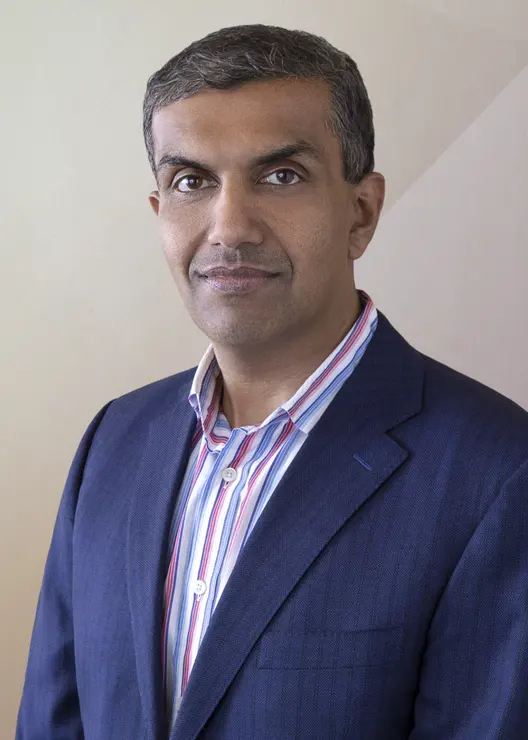
1. Business Role
Chakravarthy's Adobe role can be summarized as:
customer-experience operator
+
worldwide enterprise go-to-market leader
+
CEO-designate
The useful analysis is therefore:
- what business he has already built inside Adobe;
- what company he is about to inherit;
- why the board selected an enterprise-platform leader;
- what should not yet be attributed to his CEO tenure.
He combines product responsibility with field operations.
That is significant.
He is not only leading software development.
He has also been responsible for:
- enterprise sales;
- professional services;
- customer success. [S3]
This puts him close to both product architecture and how enterprises actually buy Adobe.
2. The Business He Inherits
When Chakravarthy becomes CEO, Adobe will already be:
96% subscription revenue
+
$27B+ ARR
+
1B+ MAU
+
large creative franchise
+
$5B+ Digital Experience business
+
rapid AI transition
The inherited challenge is not to "move Adobe to the cloud."
That transformation is complete.
The new problem is:
How does Adobe grow in an AI era where models can commoditize creation, software interfaces can become agents, and customer discovery moves from search engines to AI systems?
3. Business Thesis
The best-supported theses come from Chakravarthy's existing Adobe record.
Thesis 1 — Customer experience needs a shared context layer
Experience Platform sits under Adobe's enterprise applications.
Business implication
Customer data should be reusable across:
- analytics;
- journeys;
- personalization;
- agents.
Thesis 2 — Enterprise content and customer experience are one operating problem
Under his leadership Adobe increasingly connects:
content supply chain
with
customer engagement
through GenStudio and CX Enterprise.
Thesis 3 — AI agents will coordinate enterprise workflows across applications
CX Enterprise moves toward:
goal
↓
agent orchestration
↓
multiple tools / systems
rather than one user manually navigating each application.
Thesis 4 — Distribution / field operations matter as much as product
Chakravarthy also leads worldwide enterprise field operations.
Business implication
A complex enterprise platform succeeds only if:
- sales;
- services;
- implementation;
- customer success
can make the product usable in real organizations.
4. Strategic Bets
Strategic Bet 1 — Integrate Workfront
Adobe completed Workfront shortly after Chakravarthy joined.
THE PROBLEM
Enterprise content production needed stronger work management.
THE BET
Integrate planning / work management into the Experience stack.
THE BUSINESS IMPACT
Workfront became a core building block of GenStudio / content supply chain. [S39]
Strategic Bet 2 — Build Experience Platform into the foundation
Strategic Bet 3 — Build GenStudio
THE PROBLEM
AI increases content demand faster than enterprise content operations can scale.
THE BET
Connect creation, work management, asset management, activation and measurement.
THE BUSINESS IMPACT
GenStudio became one of the main bridges between Adobe's two large businesses.
Strategic Bet 4 — Acquire Semrush
THE PROBLEM
AI interfaces and search changes affect how customers discover brands.
THE BET
Add SEO / GEO / brand visibility to Adobe's enterprise stack.
THE RESULT
Semrush acquisition closed April 2026. [S28]
THE BUSINESS IMPACT
Adobe expanded from orchestrating known customer relationships into helping brands remain discoverable earlier in the journey.
Strategic Bet 5 — CX Enterprise
THE PROBLEM
Traditional application suites still require humans to coordinate too many steps.
THE BET
Build an agentic orchestration layer.
THE RESULT
Adobe introduced CX Enterprise in 2026. [S24]
THE BUSINESS IMPACT
Adobe is repositioning enterprise software around agentic workflow rather than only application modules.
5. How Those Bets Changed the Business
Product
Experience Cloud applications
↓
Experience Platform
↓
GenStudio
↓
CX Enterprise
Customer problem
marketing application
→
end-to-end customer experience orchestration
Distribution
Chakravarthy's combined field / product role ties enterprise sales more closely to product strategy.
Company position
His appointment signals that Adobe's enterprise customer-experience business is central to the next leadership era.
This is evidence of importance, not proof that Adobe will become primarily an enterprise-marketing company.
6. Resource Allocation
Documented areas under Chakravarthy's leadership include:
- Experience Platform;
- GenStudio;
- Workfront;
- customer-experience AI;
- Semrush;
- enterprise field operations.
The pattern is clear:
data
+
content
+
orchestration
+
go-to-market
7. Business Model: Before vs. After
There is no valid CEO before / after comparison yet.
The correct comparison is his business scope inside Adobe:
| Dimension | Joined Adobe in 2020 | By 2026 |
|---|---|---|
| Core responsibility | Digital Experience | Customer Experience Orchestration + field operations |
| Platform | Experience Cloud | AEP + GenStudio + CX Enterprise |
| AI | Earlier AI / analytics | Agentic CX |
| Acquisition integration | Existing DX portfolio | Workfront + Semrush |
| Corporate scope | Business leader | CEO-designate |
8. What Worked / What Didn't
WHAT WORKED — Digital Experience growth
FY2025 Digital Experience revenue reached $5.864B. [S1]
WHAT WORKED — Experience Platform became a shared context layer
Adobe increasingly builds enterprise applications and agents around AEP.
WHAT WORKED — GenStudio gained strategic importance
Adobe explicitly highlights GenStudio as a bridge across company segments. [S1]
TOO EARLY — CEO performance
Chakravarthy's CEO tenure has not started.
It is therefore incorrect to write:
"Under CEO Chakravarthy..."until December 1, 2026 and until actual decisions occur.
9. Business Legacy
Chakravarthy does not yet have an Adobe CEO legacy.
His existing Adobe legacy is:
helping move the Digital Experience business from a collection of marketing applications toward an integrated customer-experience orchestration platform.
The CEO question remains future-facing.
Career Timeline
Senior leadership roles at Symantec, VeriSign and Informatica; CEO of Informatica.
Joins Adobe to lead Digital Experience. [S3]
Adds worldwide field-operations responsibility.
Promoted to President, Digital Experience and worldwide field operations.
Leads Customer Experience Orchestration strategy, GenStudio and enterprise AI expansion.
Semrush acquisition closes.
Named CEO-designate. [S3]
Scheduled to become President and CEO.
Common Misconceptions
"Chakravarthy is already Adobe CEO."
No.
Not until December 1, 2026.
"He is mainly a sales executive."
Too narrow.
His Adobe role has included product strategy, engineering, product management, marketing and field operations.
"His CEO strategy is already proven."
No.
His pre-CEO enterprise record is documented; CEO-era conclusions are premature.
Evidence
- Adobe named Chakravarthy CEO-designate effective December 1, 2026. [S3]
- He joined Adobe in January 2020 and led Digital Experience plus worldwide field operations. [S3]
- Adobe credits his leadership with Experience Platform, GenStudio, Workfront, Semrush and Customer Experience Orchestration. [S3]
- Digital Experience generated $5.864B in FY2025. [S1]