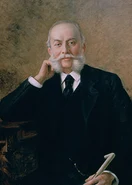
1. Business Role
Charles Pfizer helped build a company that produced chemicals customers could use reliably and obtain in commercial quantities. The early operating problem connected chemistry, production, quality and distribution. It was not the modern model of conducting multinational clinical trials and securing patent-protected pharmaceutical launches.
His record is therefore useful for understanding how manufacturing competence can support a durable enterprise. The company's later history demonstrates what subsequent people built on that foundation, rather than extending his individual responsibility across another century.
2. The Business He Started
The company began as a chemical producer in an expanding American market. Customers required materials of consistent quality, and growth required more than knowing a chemical process: the business needed capacity, working capital and channels through which to sell output.
The official history describes expanding product demand and commercial reach. Those developments show an organization becoming more capable of serving customers at scale, even though its products and regulations differed substantially from those of a present-day pharmaceutical company. [S27][S53]
3. Business Thesis
Make technical knowledge commercially reliable
The observable business direction combined chemical production with dependable supply. A process has limited commercial value if it cannot be repeated economically or if customers cannot rely on the resulting material.
Expand around useful production capabilities
An established organization can extend its customer base and product range when its capabilities fit additional demand. This is a business interpretation of the company's early development, not a claim that the founder anticipated the later vaccine or oncology portfolio.
4. Strategic Bets
Build a production business
The founders committed to operating facilities and supplying products rather than selling an isolated scientific idea. That created an opportunity to serve recurring customer needs and an exposure to costs that had to be recovered through actual sales.
Combine manufacturing and commerce
Production and customer access needed to grow together. Reliable output without customers would tie up resources; orders without adequate production would damage reliability. The early company had to solve both sides of the transaction.
Establish an organization that could continue beyond its founders
The company's persistence required people, operating practices and accumulated knowledge beyond one individual. Later advances depended on that continuing institution but also on new scientists, managers and technologies. Institutional continuity is not the same thing as personal authorship of later discoveries.
5. How the Bets Changed the Business
The early chemical business developed manufacturing and commercial foundations that later teams could adapt. Its legacy is organizational capacity: a company able to produce, sell and reinvest, rather than ownership of every scientific field it would subsequently enter.
The transition to fermentation and later antibiotics required additional knowledge. Treating those changes as inevitable would erase the technical work and investment carried out after the founder's lifetime.
6. Resource Allocation
For this period, the relevant resources were production equipment, materials, employees and the money tied up between purchasing inputs and receiving payment. Modern R&D portfolio categories would misdescribe those operating choices.
The available historical sources do not disclose every factory budget or personal decision. It is more precise to explain the production and commercial constraints than to invent an allocation model or private motive for the founder.
7. Business Model: Before vs. After
| Dimension | Founding business | Later Pfizer |
|---|---|---|
| Core activity | Chemical production and commercial supply | Research, development and global commercialization of medicines |
| Technical foundation | Chemistry and reliable manufacturing | Additional biology, clinical science and complex production technologies |
| Attribution | Charles Pfizer and Charles Erhart's founding organization | Successive scientific teams and leadership generations |
8. What Worked and What Remains Undocumented
The enduring company and its early expansion support the conclusion that the founders built a viable manufacturing enterprise. They do not establish the outcome of every early product, the profitability of every facility or an uninterrupted strategy extending into modern biotechnology.
The explicit historical limit is important: Pfizer's timeline places the founder's death in 1906 and the mold-fermentation advance in 1919. Assigning the latter to Charles Pfizer personally would be incorrect. [S27]
9. Business Legacy
His legacy is the founding institution and its initial combination of technical production with commercial reliability. Later researchers and operators transformed that institution through different technologies and markets. Crediting the foundation should preserve those later contributions.
Career Background
Pfizer's anniversary account identifies the two immigrant cousins and connects the early enterprise with chemistry and production. That context explains the starting capabilities; it does not justify retroactively describing either founder as a leader of modern clinical or molecular research. [S53]
Career Timeline
Common Misconceptions
Founding Pfizer is different from developing its later production technologies
The company name survives across many scientific generations. It does not make the founder the developer of programs undertaken after his death, including the 1919 mold-fermentation advance. [S27]
Evidence
Founding chronology and later-event boundary: [S27]. Founding-era commercial and manufacturing context: [S53]. Broader institutional history: [S28].