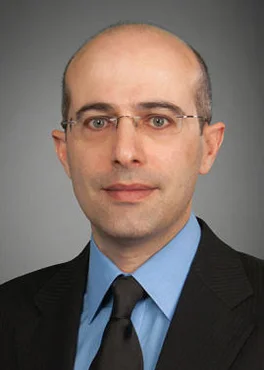
1. Business Role
Kawwas's role is to lead a semiconductor business serving customers with different equipment, workload and deployment requirements. The responsibilities connect commercial selection with physical execution: a design has to fit the customer and then be delivered through a functioning supply chain.
That makes him relevant to the transition from individual product discussions toward a broader infrastructure proposition. His public statements explain the connection among custom accelerators, Ethernet and optical technologies. The statements provide evidence of an articulated business strategy, not authorship of every underlying invention. [S7]
2. The Business He Inherited
Kawwas took the semiconductor-group presidency in July 2022 after earlier sales and operating responsibilities. The portfolio already contained substantial communications, connectivity and storage capabilities. The role was not to create a semiconductor company from a blank sheet. [S1][S5]
The commercial challenge was to keep established product relationships useful while responding to changing infrastructure requirements. Customers needed components and platforms that could fit real systems, with the accompanying software, manufacturing and delivery support.
The subsequent AI expansion increased the scale of those demands. More complex programs made the coordination of customer architecture, networking and supply capacity more important to execution.
3. Business Thesis
Kawwas's documented public framing emphasizes a network-centered infrastructure approach linking custom compute with standards-based connectivity. The business implication is that faster processing creates a need to move information efficiently around the system. [S7]
The strategic proposition is therefore broader than winning a processor specification comparison. Broadcom can supply several technologies that help a customer assemble usable infrastructure.
The strategy places value on connecting related products around the customer's system. Customers retain important architectural decisions, and the resulting designs reflect work by multiple organizations rather than one executive's technical choices.
4. Strategic Bets
Connecting custom compute and merchant networking
The 2024 infrastructure announcement explicitly brought these product areas together in Kawwas's public explanation. The mechanism is to address compute and communication as related parts of the customer's system. [S7]
The risk is coordination. A customer still needs software, packaging, equipment and an operating environment. A broad portfolio creates more opportunities to help, while also requiring precise integration and clear responsibility.
Building multi-generation customer relationships
The OpenAI and Meta collaborations provide documented examples of programs extending beyond a single release. Their commercial significance is the possibility of aligning development with a customer's longer-term infrastructure plan. [S13][S51]
The evidence supports company-level relationships under Kawwas's semiconductor leadership. It does not establish that he personally negotiated every term or designed the customer architectures. Future generations and capacity objectives remain plans until their outcomes are verified.
Treating physical supply as part of the strategy
The AST substrate announcement includes Kawwas's explanation of the importance of additional capacity to Broadcom's roadmap. It connects a public technology strategy to the physical inputs required for delivery. [S15]
The mechanism is straightforward: a complex design needs suitable production and package materials before it becomes a shippable system. The constraint is that a supplier facility and Broadcom's customer deployments have their own execution schedules.
5. How Those Bets Changed the Business
At the product level, the strategy connects multiple functions instead of describing each component in isolation. At the customer level, it can deepen relationships with organizations designing large infrastructure systems.
The distribution and commercial process can also change. A merchant part may be selected by an equipment maker; a custom program can involve closer cooperation with the organization planning the workload and deployment.
The resulting industry position is a supplier participating across more of the communications and compute path. That is different from owning the entire customer service, and it does not remove dependence on other participants.
6. Resource Allocation
The visible resource priorities include semiconductor development, interfaces, packaging and manufacturing coordination. Public product milestones show where the organization has directed effort, while the supplier announcement identifies a physical capacity requirement. [S8][S44][S15]
These facts support a leadership-level assessment of priorities. They do not disclose an exact personal budget allocation by Kawwas. Assigning precise spending or engineering headcount to him would require additional evidence.
The operating responsibility is to match resources to credible customer programs. Overcommitting before demand is ready can create risk; underpreparing can leave a customer unable to deploy when its program needs capacity.
The AST example makes that trade-off tangible. Opening a substrate facility prepares an input needed for later systems, but the announced opening and targeted manufacturing start are not the same event. A commercial roadmap must allow time for qualified physical output to become available. Kawwas's documented operating remit makes that coordination relevant to his role without implying ownership of the supplier or direct control over every production result. [S15]
A similar distinction applies to switching products. The initial Tomahawk 6 introduction described a design and intended capabilities; the later production-volume release described a different execution milestone. The organization has to connect those stages with equipment makers and customers before the component can contribute to an operating network. [S8]
7. Business Model: Before versus After
| Dimension | Established portfolio emphasis | Infrastructure-oriented expansion |
|---|---|---|
| Product proposition | Specific semiconductor and connectivity functions | Related compute, networking and optical capabilities around a larger system |
| Customer engagement | Equipment design and component selection | Also multi-generation co-development and deployment planning |
| Execution requirement | Qualified products and reliable delivery | Those requirements plus more coordination across packaging, networks and facilities |
| Competitive question | Whether a component fits the design | Whether the combined capability helps the customer operate useful infrastructure |
The comparison describes the changing emphasis of a business he leads. It is not a claim that older markets disappeared or that every product now belongs to an AI program.
8. What Worked and What Did Not
Named customer collaborations and dated product-shipment announcements establish observable progress. Tomahawk 6's production-volume announcement and the 3.5D compute-SoC milestone are stronger evidence of execution than an undated aspiration. [S8][S44]
The limits remain important. A shipping component does not prove that the customer's complete system is operating at intended scale. Supplier capacity, software and facilities can still determine the ultimate outcome.
The unfinished programs expose a particular operating risk: development, components and customer facilities may advance at different speeds. Extra network capacity cannot compensate for an unavailable accelerator, and a completed accelerator cannot compensate for an unfinished site. Coordinating those dependencies remains part of the job rather than an outcome established by an announcement.
9. Business Legacy
Kawwas's structural contribution to date is associated with connecting customer-facing semiconductor capabilities to a broader infrastructure proposition, while making operations and physical inputs visible parts of that proposition.
The outcome remains collective. Product engineers, manufacturing partners, customers and other Broadcom leaders contribute to the systems delivered. His role helps explain organization and priorities without absorbing those participants' work into one person's biography.
The lasting organizational change is the need to manage the interface among product groups and customer systems. Custom compute may use customer-specific architecture while merchant networking serves several equipment makers. Supply commitments have to support both models without assuming they share the same demand pattern. The public strategy makes those connections visible; their continuing usefulness depends on how well teams execute them as requirements change. [S7]
That is a more specific contribution than simply being present during an AI growth period. It concerns how a semiconductor organization explains, sells and delivers related capabilities. The wider market created an opportunity, while the company's choices determined which parts of that opportunity it pursued and which dependencies it accepted.
Career Background
Kawwas joined the predecessor organization through the LSI acquisition. His earlier responsibilities included sales, product-related and operating roles, followed by chief operating officer and semiconductor-group leadership positions. That background is relevant because the current role requires coordination across customers, product capabilities and execution. [S5][S6]
The sequence of sales, operations and group leadership roles connects customer requirements with the resources needed to serve them. It helps explain a position concerned with commercialization and execution across product groups, rather than the invention of one isolated device.
Career Timeline
- 2014: Enters the Broadcom predecessor organization through LSI's acquisition, according to the documented career history. [S5][S1]
- 2020: Becomes chief operating officer under the announced leadership changes. [S6]
- 2022: Becomes president of the Semiconductor Solutions Group. [S1]
- 2024: Publicly explains the integrated custom-compute and networking strategy. [S7]
- 2025–2026: Named customer collaborations and product milestones extend that strategy into specific programs. [S13][S14][S51][S8]
- 2026: The AST announcement documents the importance of additional substrate capacity. [S15]
Common Misconceptions
“Kawwas personally designed every Broadcom AI chip.”
The sources establish executive responsibilities and public strategy. They do not turn an organization's engineering work into personal invention.
“Announced customer capacity is already operating capacity.”
“Operations is separate from the technology strategy.”
A design needs manufacturing, packaging and delivery. The substrate-capacity announcement makes that connection explicit. [S15]