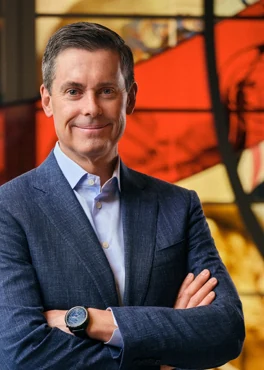
1. Business Role
Ricks leads a company in which scientific, physical and commercial success must line up. A promising candidate needs clinical evidence; an approved medicine needs qualified supply; a supplied product needs an appropriate route through healthcare and payment.
The CEO's choices concern that connected system. They include which programs to support, which outside capabilities to acquire and how early to commit manufacturing resources. The role is organizational leadership, not personal authorship of every molecule or clinical result.
2. The Business He Inherited
Ricks took over an established pharmaceutical company with research teams, a manufacturing network, marketed medicines and programs already in development. It was not a startup created around the later obesity expansion.
That starting point created both capability and obligation. Existing products supported current operations while scientific and competitive change created a continuing need to renew the portfolio. New medicines could expand the business, but development outcomes remained uncertain.
The later company therefore combines inherited research and infrastructure with subsequent decisions. A product approved during his tenure is not, by that timing alone, a program he initiated or a medicine he personally discovered.
3. Business Thesis
The observable company strategy combines new medicine development with the capacity and access needed to use the resulting products. Ricks's Q2 2026 public framing emphasizes current growth alongside future programs, manufacturing and acquired assets. [S3]
The business implication is that demand alone is insufficient. Lilly has to support an entire route from evidence to dependable supply and funded use, while continuing to create the next set of medicines.
That connects short- and long-term allocation. Resources devoted to today's successful franchise can help serve patients now; resources devoted to uncertain research and capacity can determine the future business.
4. Strategic Bets
Preparing physical capacity for expected demand
Lilly's manufacturing expansion and the additional Indiana commitment in Q2 2026 show substantial resources directed toward supply. The investment addresses ingredients, finished products and delivery systems rather than assuming an approved medicine can instantly be supplied at any scale. [S26][S3]
The potential benefit is an ability to serve demand sooner. The risk is committing capital before the precise volume, product mix and timing are certain. A facility announcement does not establish finished output.
Combining internal research with external capability
The completed Loxo, Verve and Centessa transactions represent different development capabilities: precision oncology, cardiovascular gene editing and orexin-related neuroscience. They show a company-level portfolio approach that does not require every candidate to originate internally. [S19][S21][S24]
The mechanism is to bring programs and expertise into a larger development system. The risk is that bought science can still fail, and integration does not replace the clinical work required for approval and use.
Treating access as an operating task
LillyDirect provides evidence of a service direction around prescription support and selected product access. The practical goal is to reduce friction between an appropriate prescription and medicine supplied. [S16]
The limit is the role boundary: independent clinicians, pharmacies and payers still perform their own functions. A visible branded route cannot solve every coverage or medical issue. The service is an organizational initiative during Ricks's tenure, not proof that he personally designed every transaction within it.
5. How Those Bets Changed the Business
The recent metabolic expansion increased the importance of physical delivery and access at scale. Manufacturing and channel decisions became especially consequential because scientific and regulatory progress created substantial new demand.
External transactions also broadened the types of science Lilly could develop. A clinical-stage gene-editing program has a different risk and execution pattern from an established medicine franchise. Broader opportunity therefore created more kinds of commitments to coordinate.
The resulting business is not explained solely by a list of successful brands. The structural change concerns how development, manufacturing and access are connected, and how current success funds work whose outcome is still uncertain.
6. Resource Allocation
Lilly must divide resources among research, evidence generation, production, commercialization and acquired programs. Some commitments support current revenue; others precede approval and may never generate a marketed product.
Pre-launch preparation illustrates the trade-off. Inventory and capacity can shorten the delay between approval and access, but they create exposure if a regulatory or commercial outcome differs from expectations. [S1]
The CEO is responsible for the corporate balance, not a guaranteed outcome from every project. Product teams, scientific leaders, manufacturing executives, partners and regulators all influence what the committed resources ultimately deliver.
7. Business Model: Before versus After
| Dimension | Established business inherited | Subsequent development under his tenure |
|---|---|---|
| Portfolio | Marketed medicines and an existing pipeline | Larger recent metabolic franchises and additional acquired scientific approaches |
| Supply task | Maintain and expand regulated production | Coordinate major additional capacity with rapidly changing demand |
| Commercial task | Existing healthcare and distribution relationships | Also new access routes and high-volume product pathways |
| Allocation question | Replace aging products and fund research | Do so while serving a larger current business and integrating more external programs |
The comparison describes changing emphasis, not abandonment of older medicines or proof that all current growth resulted from CEO decisions alone.
8. What Worked and What Did Not
The FDA approval of Foundayo and Kisunla's authorized treatment role establish concrete product outcomes. Q2 2026 reporting establishes substantial current growth. Those results are stronger evidence than an announcement of future potential, while remaining different from universal patient benefit or success of every investment. [S5][S33][S3]
The solanezumab A4 study supplies a documented negative result. It did not slow cognitive decline in the studied preclinical population, and Lilly concluded that program's clinical development. The trial began before Ricks became CEO, so its initiation cannot fairly be assigned to his tenure. [S39][S40]
The contrast illustrates portfolio uncertainty: a company can report important successes while another scientifically plausible program fails. Future gene-editing and other acquired candidates still require evidence rather than inheriting the success of current products.
9. Business Legacy
Ricks's structural contribution to date is associated with coordinating a larger medicine business around development, manufacturing expansion, external capabilities and access. That organizational problem is more specific than a reputation for overseeing growth.
The legacy remains unfinished. Capacity has to become dependable output, programs have to survive testing and current franchises have to remain useful as competition changes. The results belong to a broader organization and its partners, with leadership accountable for the choices and commitments connecting them.
Career Background
Ricks joined Lilly in 1996 in business development. His later roles included marketing and sales, country leadership in Canada and China, Lilly USA and Lilly Bio-Medicines. That sequence is relevant because the CEO role connects scientific development with markets and operating execution. [S17]
Career Timeline
- 1996:
Joins Lilly in business development. [S17]
- 2012:
Becomes president of Lilly Bio-Medicines. [S17]
- 2017:
Becomes CEO in January and chair in June. [S17]
- 2019:
Loxo acquisition completes during his CEO tenure. [S19]
- 2023:
A4 negative results are disclosed; the program's origins predate his CEO role. [S40]
- 2025–2026:
Common Misconceptions
“Ricks personally discovered every medicine approved during his tenure.”
The medicines reflect work by internal teams, predecessor programs, partners and acquired organizations. CEO leadership is a different contribution.
“Strong growth proves all capital commitments have already paid off.”
Reported results describe a period. Capacity projects and clinical programs can have later, uncertain outcomes.
Evidence
The biography establishes the role and earlier responsibilities. Filings and dated corporate events establish resource commitments and company outcomes. FDA decisions and the A4 primary report provide separate evidence of successful regulatory outcomes and a negative clinical result. [S17][S1][S3][S19][S21][S24][S5][S33][S39]
Connected Entities
Daniel Skovronsky explains a distinct scientific and product leadership role. Loxo Oncology, Verve Therapeutics and Centessa Pharmaceuticals explain the acquired capabilities themselves.