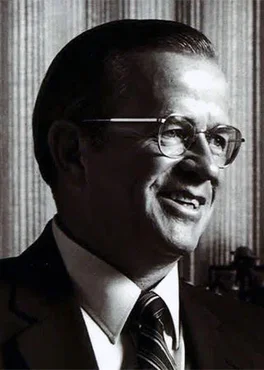
1. Business Role
Organizing institutions that competed
Hock worked on a business with a coordination problem.
A bank wanted to issue a useful payment product, retain its customers and compete with other banks.
Yet the product became more useful when it worked at merchants connected through other institutions.
That meant rivals needed to agree on part of their operation without merging their whole businesses.
His leadership task was to make that shared undertaking viable.
An organization, not just a card
The card was a visible object carried by a customer.
Its usefulness depended on less visible relationships: who would accept it, who would authorize the payment and how institutions would settle their obligations.
A common logo could identify the system. It could not by itself make those obligations dependable.
Hock helped develop the institution behind that coordination.
The technological work required teams; the institutional work required agreement among participants.
2. The Business He Started From
A troubled existing program
Hock did not begin with a blank sheet or invent an entirely new form of consumer credit.
BankAmericard already existed.
His own career account describes weak credit controls and inadequate authorization and interbank clearing processes as banks expanded their programs. [S101]
The operating problem was a system whose reach could grow faster than its ability to manage transactions and losses.
His position inside the problem
Hock led BankAmericard activities at Seattle's National Bank of Commerce.
He therefore encountered the difficulty from the position of a participating bank, not only from a central organization's office. [S101]
A local program could not make the wider arrangement reliable on its own.
That connected his institution's interest to a common-system problem.
More issuance was not enough
Adding cards might increase potential activity.
If participants could not trust the transaction process, additional activity could also spread operational difficulty.
The constraint was not simply demand for credit.
It was the capacity to coordinate a growing set of independent institutions.
3. Business Thesis
Cooperate on the shared system
Hock's later writing argues that competition and cooperation can support each other.
He uses Visa as an example of organizations with semi-independent participants linked by a common purpose. [S103]
Applied to the payment business, the logic is concrete.
Banks could compete in customer relationships while cooperating on the infrastructure needed to transact across those relationships.
Treat agreement as an operating asset
In another essay, Hock describes organization through agreement, shared purpose and expected conduct.
He also recognizes that formal rules cannot specify every circumstance. [S102]
A payment system still needs practical standards and obligations.
The commercial implication is that a rulebook alone is not enough if institutions do not accept the purpose or behave in ways that sustain confidence.
These later essays state his philosophy. They are not word-for-word records of the founding negotiations.
4. Strategic Bets
Bet 1 — Reorganize the common undertaking
The starting problem involved many banks with different interests and a troubled shared program.
Hock's published account describes committee work followed by the creation of National BankAmericard Inc. in 1970, with him as president and CEO. [S101]
The commitment was organizational: create a structure through which participants could address the common system.
The mechanism was making cooperation part of how the business operated rather than relying on each local program to fix interbank problems separately.
The risk was continued conflict.
A participant could support cooperation in principle while opposing a particular decision affecting its own economics.
The result was a new organization, not ownership of all the participating banks.
Bet 2 — Make processing a common capability
Institutional agreement needed an operating system.
Visa's memorial records Hock pushing his team toward VisaNet's 1973 launch. [S23]
The business mechanism was shared computerized transaction handling.
A bank could connect to common infrastructure rather than independently recreate every relationship with every other participating institution.
The trade-off was dependence.
As participants used the same infrastructure, its availability and processing quality became important to more businesses at once.
The launch was a team achievement. The commercial value came from what institutions could do through the system, not only from owning computers.
Bet 3 — Give the system a broader identity
The BankAmericard name carried a particular bank and country association.
A common international payment identity needed to work across the participating organizations.
Visa dates the brand change to 1976 and describes an internal naming process. [S23][S78]
The mechanism was a shared signal at issuance and acceptance points.
A customer could recognize a network identity beyond the name of one issuing institution.
A merchant could communicate acceptance without explaining the entire interbank arrangement.
The brand supported the network. It did not replace the rules, institutional relationships or processing beneath it.
5. How Those Bets Changed the Business
Product
The business became a shared system supporting separate financial products.
That is different from a single lender expanding only its own card portfolio.
Customer
Participating institutions were central to the network's operation.
Consumers and merchants benefited through products and connections supplied by those institutions.
Revenue logic
The common system supported payment activity performed by others.
Its economic purpose was not limited to earning interest on a centrally owned consumer-loan book.
Modern Visa's exact fees and accounting categories should not be projected unchanged onto the 1970 organization.
Distribution
Banks could extend a common identity and capability through their own relationships.
The central organization did not need to become the branch network of every participating bank.
Moat
The useful combination was participation plus the ability to transact dependably across participants.
A name without acceptance was weak. Acceptance without reliable processing was also weak.
Industry position
The network occupied a coordinating role between otherwise independent financial businesses.
That helped make shared infrastructure a distinct commercial layer rather than a function that every bank had to own alone.
6. Resource Allocation
Agreement before effortless scale
Committee work and institutional negotiation required management time.
That effort addressed a real dependency: technical infrastructure would have limited reach if participating banks did not adopt a common arrangement.
Organizational capacity was therefore an investment in whether the system could function.
Shared technical capacity
The processing commitment used technical teams to build a capability serving many institutions.
The economic leverage came from reuse.
A common function could support repeated transactions across participants instead of each transaction requiring a new bilateral arrangement.
The corresponding obligation was keeping that shared function dependable.
Distributed customer operations
Banks continued to run their own customer businesses.
That distributed product operations and customer relationships across participants rather than bringing every account into the central organization.
It also meant the network could not solve every issue by ordering one vertically integrated workforce to change.
Its reach depended on organizations with their own priorities.
7. Business Model: Before vs. After
| Dimension | The starting program's constraint | The organization developed during Hock's leadership |
|---|---|---|
| Value created | A bank-card product constrained by system coordination | Common payment usefulness across independent participants |
| Core product | Card programs and licensed participation | Shared organization, processing and network identity |
| Buyer/participant | Separate banks confronting common operating problems | Institutions participating in a common system |
| End user | Customers dependent on their bank's program and wider acceptance | Customers using institution-issued products across a broader network |
| Revenue logic | Card-program economics plus interbank operating difficulty | Common-system services distinct from each institution's lending economics |
| Software role | Inadequate shared transaction-handling processes | Computerized common processing |
| Distribution | Existing banks and licensing relationships | Participating institutions extending a common network |
| Scale | Expansion could amplify unresolved problems | Repeatable coordination supported wider participation |
| Boundary | A troubled arrangement around BankAmericard | A separate organization without ownership of every member bank |
The table describes operating changes, not a reconstructed historical income statement.
The current public company, its later acquisitions and today's products belong to subsequent periods.
8. What Worked / What Didn't
The institution became durable
The organization gained a shared processing capability and a lasting Visa identity.
Those outcomes show that independent institutions could sustain a common payment undertaking.
They also distinguish the achievement from a clever concept that never became operational.
Early expansion exposed an unresolved operating problem
The starting program's credit and processing weaknesses show why more participation alone was insufficient.
The network needed an organization able to deal with the consequences of scale.
Those operating weaknesses preceded the new organization and shaped the work it needed to do.
The model did not abolish operating risk
Sharing infrastructure changes where risk is coordinated. It does not make transactions, settlement or technology infallible.
Visa's modern reporting continues to describe operating and settlement exposures. [S1]
Those present-day risks should not be assigned retroactively to a leader who left in 1984.
They show the continuing work required by the kind of system he helped organize.
9. Business Legacy
Hock's lasting contribution is the institution of shared payment coordination.
Financial businesses could retain separate customers and compete while using infrastructure that made the whole system more useful.
The contribution combined organization with actual processing and a recognizable identity.
None of those parts alone fully explains the outcome.
Its continuing significance is visible whenever an independently supplied payment product works beyond its own institution's immediate relationships.
Later teams maintained, reorganized and extended that system. The founder's contribution is substantial without becoming personal authorship of every later Visa capability.
Career Background
Hock worked in consumer finance and regional financial operations before leading BankAmericard activities at National Bank of Commerce. [S101]
That background placed him inside the practical work of financial institutions.
After leaving Visa, he developed his organizational ideas through writing and speaking.
The later philosophy helps explain his stated perspective, while the business history still depends on what the organization actually built.
Career Timeline
- 1966–1970:
leads BankAmericard activities at National Bank of Commerce.
- 1969:
bankers' coordination meeting described in Visa's memorial.
- 1970:
National BankAmericard Inc. established with Hock as president and CEO.
- 1973:
VisaNet launch.
- 1976:
the shared Visa brand introduced.
- 1984:
leaves Visa.
- 2022:
dies; Visa publishes its memorial.
Common Misconceptions
“He invented the credit card.”
The BankAmericard program predated his founding leadership.
“A shared network meant banks stopped competing.”
They still had their own customer relationships and commercial interests.
“He personally built every technical system.”
Computerized processing was developed by teams within a wider institutional effort.
“The modern listed company existed in the same legal form in 1970.”
Visa Inc.'s current corporate lineage includes a later reorganization.
“Today's products were all part of his original implementation.”
Modern credentials, agent-payment products and stablecoin operations belong to later development periods.
Evidence
- [S101] Operating background, committee history and the 1970 organization.
- [S23] Founder designation, processing and brand milestones, departure and death.
- [S102], [S103] His published organizational ideas.
- [S77], [S78], [S20] Later corporate and brand history.
- [S1] Present-day operating boundaries, not evidence of his private decisions.