1. Business Role
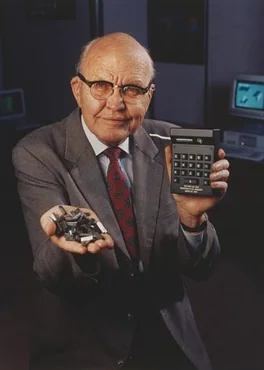
His influence therefore operated through technology and engineering possibility rather than the capital-allocation authority of a chief executive. The distinction matters: a person can change a company's opportunities without controlling its factories, pricing or acquisitions.
2. The Problem He Confronted
Electronic systems need multiple elements connected in a functioning circuit. Adding more discrete components also adds interconnections, assembly steps and opportunities for failure. A better individual transistor does not by itself solve that system-level complexity.
The integrated-circuit idea addressed the arrangement of the whole function. Instead of treating every element as a separate item to assemble, it explored making the circuit's functions together. The commercial implication was a route toward more capability with fewer external connections, though the first demonstration did not immediately deliver modern production economics.
3. Technical and Business Thesis
Kilby's insight was valuable because it changed where complexity could be handled. Some work could move from assembling separate pieces toward engineering and manufacturing an integrated device. That is a different economic problem with its own advantages and costs.
Once functions are integrated, design and process capability become more important, while some assembly work can diminish. A successful approach can improve repeatability and make new applications practical. But the change is not automatic: process reliability, interconnection methods and customer adoption still have to be solved.
4. Strategic Bets Associated With the Work
Demonstrating a principle rather than only proposing it
The September 1958 demonstration supplied working evidence of the concept. That matters because an operating circuit changes what an organization can test and fund. It moves a claim from an abstract possibility toward an engineering program. [S28]
The prototype should not be mistaken for a modern monolithic chip. Its historical importance lies in proving a route forward, not in matching today's integration density or cost.
Treating interconnection as a central problem
The historical integrated-circuit record distinguishes Kilby's demonstration from subsequent approaches, including work associated with Robert Noyce. The development of practical production methods was part of a broader technical history, not the work of one company alone. [S51]
Recognizing this distinction strengthens the explanation. It shows why an invention can be foundational even when further inventions and manufacturing changes are required before it becomes an industry.
5. How the Work Changed the Business Opportunity
The causal chain separates invention from commercialization. A prototype expands the feasible set; engineering and production determine what can be delivered; customers determine which applications justify adoption. All three stages matter to the business outcome.
For TI, integration became part of a wider semiconductor identity. The company's subsequent history includes calculators, microcontrollers and DSPs, but those later products require their own teams and evidence. They should not be assigned to Kilby merely because they depended on integrated circuits. [S8]
6. Resource Allocation
Kilby's contribution illustrates the value of time, laboratory resources and technical freedom directed at a difficult underlying constraint. The work required experimenting with a different arrangement rather than merely optimizing an established component.
That does not establish a universal instruction to fund every speculative project. The useful distinction is between a testable technical question and a vague aspiration. A demonstration produces evidence an organization can use to decide what engineering and capital should follow.
No undocumented research budget or personal control over later fab investment is implied. The scientist's leverage and the executive's leverage are different, even when both are necessary to commercialize a breakthrough.
7. Business Model Before and After
| Earlier constraint | Opportunity created by integration |
|---|---|
| Many separately assembled circuit elements | More functions implemented within an integrated device |
| External connections grow with complexity | Some complexity shifts into design and fabrication |
| Miniaturization limited by assembly | New routes toward compact, repeatable electronics |
| Component improvement alone | Circuit-level architecture becomes a major lever |
These are explanatory contrasts, not numerical claims about the first prototype's production cost or its immediate sales.
8. What Worked and What Remained Unsolved
The working demonstration established technical possibility. It did not settle high-volume yield, the best interconnection method, standardized design practices or the economics of every application. The broader development record is important precisely because those additional problems remained. [S28][S51]
A retrospective account should avoid the opposite mistake as well: requiring the first prototype to look like a modern chip before recognizing its significance. Early evidence can be decisive without being a finished commercial system.
9. Business Legacy
Kilby's legacy is a change in the feasible architecture of electronics. It helped make the integrated circuit a platform on which later companies and engineering teams could build, including competitors as well as TI.
The business lesson is not that invention automatically creates monopoly profits. A foundational idea can expand an industry while value is distributed among process developers, manufacturers, designers and system companies. Sustained commercial advantage requires continued execution after the initial discovery.
Common Misconceptions
Kilby alone created the entire modern semiconductor industry
No. His demonstration was foundational, while other inventors and manufacturing developments were also essential. Recognition need not erase those contributions.
The first integrated circuit was already a modern production chip
No. Demonstration and production readiness are different stages. Later technical work made integration more practical and scalable.