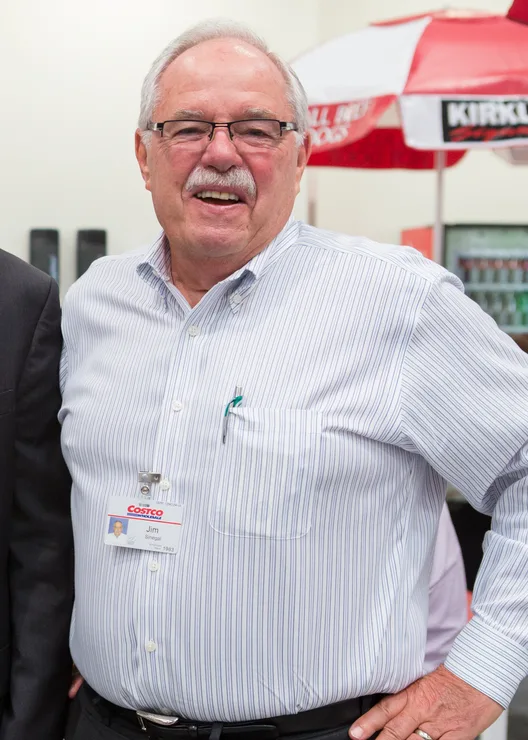
1. Business Role
Sinegal's role in Costco is best understood as:
He did not arrive at Costco as an executive learning warehouse clubs for the first time.
He had already worked with Sol Price at Price Club, where Costco's own history says he was instrumental in refining merchandising and marketing. [S5]
That matters because Costco's original advantage was not a new product.
It was a retail operating system.
Sinegal helped transfer and adapt that operating knowledge into a new company.
2. The Business He Helped Start
Costco in 1983 began with a clear commercial proposition.
Market opportunity
Bring the membership warehouse model to markets not yet well served by Price Club.
Jeff Brotman's observation was geographic: the Pacific Northwest did not have an equivalent warehouse club. [S5]
Core customer
households
+
small businesses
Value proposition
High-quality goods at unusually low prices.
Revenue logic
annual membership fee
+
low-margin merchandise
+
high sales volume
Core capability
buying
merchandising
distribution
warehouse operations
Business constraint
The model only works if members believe the fee produces enough savings and quality to justify renewal.
A conventional retailer can try to offset low traffic with higher margin.
A membership warehouse with a value promise has less room to do that without weakening its reason to exist.
3. Business Thesis
Thesis 1 — Member value comes before maximizing item margin
In a 2000 Costco announcement, Sinegal described Costco's mission as selling top-quality merchandise at the best possible prices. [S18]
Business implication
Do not optimize every SKU for the highest possible gross margin.
Optimize the system for member value and volume.
Where it showed up
low markup
membership
rapid turns
price discipline
BizTear analysis
This changes the goal of merchandising.
The buyer is not asking only:
How much margin can this item generate?
The buyer is also asking:
Will this item make the membership feel valuable?
Thesis 2 — Remove retail costs the member does not value
Sinegal publicly emphasized eliminating overhead such as elaborate displays, excess sales labor, advertising and billing. [S18]
Business implication
Spend less on retail theater and more on price.
Where it showed up
pallet displays
no-frills warehouses
self-service
limited assortment
simple fixtures
BizTear analysis
The warehouse aesthetic is not simply a brand style.
It is the visible output of a cost structure.
Thesis 3 — Fewer products can create stronger buying economics
Costco's limited-selection model concentrates volume behind chosen products.
Business implication
Choose carefully instead of offering every alternative.
Where it showed up
Fewer than 4,000 core warehouse SKUs today. [S1]
BizTear analysis
Retailers usually advertise choice as a benefit.
Costco turns less choice into a purchasing advantage.
Thesis 4 — Employees and suppliers are part of the value system
Costco's long-standing code places members, employees and suppliers before shareholder reward in the sequence of operating obligations.
Business implication
The company cannot sustain low prices through one-time supplier extraction or permanently weak store execution.
Where it showed up
- internal promotion;
- employee compensation and benefits;
- long supplier relationships;
- buyer autonomy and operating culture.
BizTear analysis
This does not mean there is never conflict.
It means Costco's model treats continuity as part of long-run efficiency.
4. Strategic Bets
Strategic Bet 1 — Adapt the Price Club model rather than build a conventional retailer
THE PROBLEM
The Pacific Northwest lacked the membership warehouse format Jeff Brotman had observed at Price Club.
THE BET
Build Costco around the same fundamental model:
membership
+
warehouse efficiency
+
low prices
+
high volume
THE MECHANISM
Paid members would concentrate spending at a low-price warehouse, creating purchasing scale.
THE RISK
Consumers could reject paying before they were allowed to shop.
THE RESULT
Costco opened in Seattle in 1983 and grew rapidly. [S5]
THE BUSINESS IMPACT
The company began with a differentiated economic model rather than competing as another supermarket or department store.
ATTRIBUTION
Directly documented
Sinegal co-founded Costco and brought direct Price Club operating experience. [S5]
Strategic Bet 2 — Preserve low overhead as the company grew
THE PROBLEM
Retail growth can add layers of cost:
- headquarters;
- store presentation;
- advertising;
- labor;
- inventory complexity.
THE BET
Keep the warehouse intentionally simple.
THE MECHANISM
Lower overhead allows more savings to be passed to members.
THE RISK
The stores could feel austere compared with conventional retail.
THE RESULT
The no-frills warehouse became part of Costco's identity.
THE BUSINESS IMPACT
Costco built scale without making conventional store presentation central to the value proposition.
ATTRIBUTION
Directly documented at the philosophy level [S18]
Strategic Bet 3 — Merge with Price Club
THE PROBLEM
Costco and Price Club were competing membership warehouse chains with overlapping operating philosophies.
THE BET
Combine the companies in 1993.
THE MECHANISM
The merger increased:
locations
purchasing scale
membership scale
management depth
THE RISK
Combining two companies can create cultural and operating conflict.
THE RESULT
PriceCostco began with 206 locations and about $16B in annual sales. [S5]
THE BUSINESS IMPACT
The merged company emerged as a much larger warehouse-club platform.
ATTRIBUTION
Leadership-level / company event
The merger occurred while Sinegal was Costco CEO; approved sources support his leadership role but do not justify treating the transaction as his individual decision alone.
Strategic Bet 4 — Build Kirkland Signature
THE PROBLEM
National brands limited Costco's control over product economics and differentiation.
THE BET
Create one broad private-label brand.
THE MECHANISM
Costco could define quality, packaging and value targets while building exclusive member products.
THE RISK
A private label carrying the Costco reputation could damage member trust if quality failed.
THE RESULT
Kirkland Signature grew across hundreds of products and dozens of categories. [S10]
THE BUSINESS IMPACT
The company added a product-development and margin lever to the warehouse model.
ATTRIBUTION
Leadership-level
Kirkland launched in 1995 under Sinegal's CEO tenure; the approved sources do not support calling it his personal invention.
Strategic Bet 5 — Add ancillary value without abandoning the warehouse
THE PROBLEM
An annual membership is more compelling when it creates savings across more recurring needs.
THE BET
Add services such as:
gas
pharmacy
optical
tires
food court
travel
THE MECHANISM
More categories create more reasons to visit and renew.
THE RISK
Each adjacent business adds operational complexity.
THE RESULT
Ancillary businesses became material traffic and sales contributors.
THE BUSINESS IMPACT
Costco evolved from a warehouse trip into a broader member ecosystem.
ATTRIBUTION
Leadership-level
5. How Those Bets Changed the Business
Product
wholesale-style merchandise
↓
curated warehouse assortment
+
private label
+
ancillary services
Customer
business members
↓
households + businesses
↓
global membership base
Revenue logic
membership + merchandise
↓
membership + merchandise + ancillary ecosystem
Distribution
warehouse
↓
warehouse + depots + e-commerce + member services
Moat
low price
↓
low price + membership + buying scale + Kirkland + operating culture
Industry position
new warehouse club
↓
global leader in membership warehouse retail
6. Resource Allocation
Sinegal's business philosophy is visible in what Costco spent resources on — and what it deliberately avoided.
Warehouses and scale
The company invested in large warehouses and distribution capability rather than elaborate retail interiors.
Merchandise buying
Buyer judgment became central because limited selection concentrates risk and volume.
People
Costco developed a culture of internal promotion and employee investment rather than treating labor purely as a cost to minimize.
Private label
Kirkland added resources to product specification, sourcing and brand trust.
Ancillary services
Gas and other member services expanded the number of ways a membership could create value.
7. Business Model: Before vs After
Price Club / early warehouse context
Value created Wholesale-like savings through efficient buying and warehouse operations.
Customer Initially business-focused, later consumers as well.
Product Limited warehouse merchandise.
Revenue logic Membership + merchandise volume.
Geography Limited U.S. warehouse footprint.
Costco when Sinegal stepped down as CEO
Value created Member savings across merchandise and services.
Customer Large household and business membership base.
Product National brands + Kirkland + fresh + ancillary + e-commerce.
Revenue logic Membership + low-margin high-volume retail + services.
Geography International warehouse network.
The core formula remained recognizable even as scale and product scope expanded.
8. What Worked / What Didn't
WHAT WORKED — The membership warehouse model
What happened
Consumers accepted paying an annual fee for access to low warehouse prices.
Why it worked
Enough members believed the savings and quality exceeded the cost of membership.
Capability created
Recurring fee income and repeat customer behavior.
WHAT WORKED — Limited assortment
What happened
Costco resisted the retail convention that more choice is always better.
Why it worked
Selected items gained very high unit volume.
Capability created
Purchasing power and rapid turnover.
WHAT WORKED — Kirkland Signature
What happened
Costco developed a trusted private label across many categories.
Capability created
Product differentiation and stronger control of the value equation.
TRADE-OFF — Low margins leave less room for execution failure
The low-price model is not free.
If Costco mismanages:
- inventory;
- labor;
- supply chain;
- shrink;
- site productivity;
the company has less markup cushion than a higher-margin retailer.
Sinegal's model worked because operational discipline was part of the strategy.
This is a constraint, not evidence of a failed bet.
9. Business Legacy
Sinegal's business legacy is structural:
From warehouse discounting
to a membership retail system

From many retail choices
to concentrated assortment

From store markup
to member lifetime value

From national brands only
to national brands + Kirkland

From low price as promotion
to low price as operating identity
The company that existed when he stepped down was much larger than the one he co-founded, but its core economics were still recognizable.
Those outcomes were built by Costco as an organization and shaped by Jeff Brotman, executives, buyers, employees, suppliers and millions of members — not by one person alone.
Career Background
Sinegal worked with Sol Price before Costco and became an important merchandising, distribution and marketing executive at Price Club. [S5]
That experience gave him direct knowledge of:
- membership;
- warehouse layout;
- buying;
- distribution;
- low-overhead retail.
He then co-founded Costco with Jeff Brotman in 1983.
Career Timeline
Price Club begins; Sinegal is part of the operating team that develops the warehouse-club model.
Co-founds Costco Wholesale with Jeff Brotman.
Costco goes public.
Costco and Price Club merge.
Kirkland Signature launches; Costco opens its first gas station.
Company returns to the Costco name.
Announces plan to step down as CEO.
Craig Jelinek succeeds him as CEO. [S17]
Common Misconceptions
"Jim Sinegal invented the warehouse club."
No.
Sol Price created Price Club before Costco.
Sinegal learned and helped refine that model before co-founding Costco.
"Sinegal founded Costco alone."
No.
Jeff Brotman was Costco's co-founder. [S5]
"Costco succeeded by maximizing retail margins."
No.
The operating philosophy emphasized low overhead and member value.
"Limited selection was just because early Costco was small."
No.
It remains a deliberate operating principle at enormous scale.
Evidence
- Costco co-founding and Price Club background: Costco Company Information. [S5]
- Stated low-price / low-overhead operating philosophy: historical Costco announcement. [S18]
- Sinegal CEO transition: 2011 Costco / SEC announcement. [S17]
- Current evidence that limited assortment and low margins remain core: FY2025 Form 10-K. [S1]