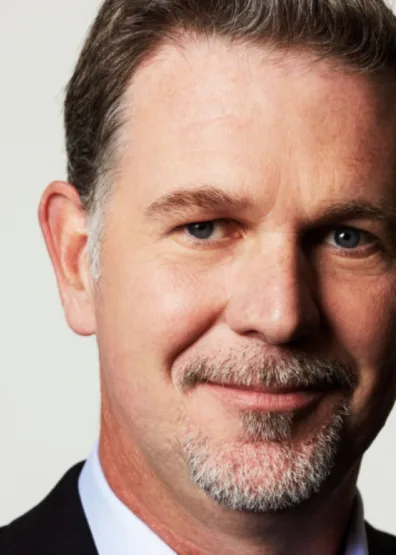
1. Business Role
Under Hastings' leadership Netflix became:
Hastings' role in Netflix was not limited to one product generation.
He led the company through businesses that required very different operating capabilities.
DVD Netflix required
postal logistics
queue management
recommendations
subscription billing
Streaming Netflix required
cloud computing
device partnerships
video encoding
content delivery
personalization
Modern Netflix requires
original production
global programming
advertising
live events
games
That makes Hastings a useful case in business-model cannibalization.
The company did not simply add a digital channel to DVD.
It eventually allowed streaming to make the DVD business obsolete.
2. The Business Hastings Helped Start
Netflix's 1998 launch was an online DVD rental and sales store.
The original opportunity was created by two changes happening at once:
internet commerce becomes practical
+
DVD becomes a new physical-media format
The customer problem was straightforward.
Physical video stores had limited local selection.
Netflix could use the internet to present a much larger catalog and mail the disc to the customer. [S7]
But the first model still had weaknesses.
It was transaction-based.
Customers could still think in terms of:
one rental
one due date
one decision
The stronger business emerged when Netflix converted that experience into recurring membership.
3. Business Thesis
Thesis 1 — Convenience can remove the friction of physical rental
The early Netflix model used the internet to separate movie selection from a local store.
Business implication
Build a centralized catalog and send DVDs by mail.
Where it showed up
Netflix.com, queues and postal fulfillment.
Thesis 2 — Subscription is stronger than transaction-by-transaction rental
Netflix launched its no-due-date, no-late-fee subscription in 1999. [S8]
Business implication
Turn movie rental into an ongoing relationship rather than repeated one-off transactions.
Where it showed up
Monthly membership, queues and repeat usage.
Thesis 3 — The internet should eventually replace physical delivery
Hastings later stated directly that he saw streaming coming and pushed for it. [S22]
Business implication
Invest in streaming before DVD had stopped working.
Where it showed up
Streaming launch, device partnerships, cloud infrastructure and Open Connect.
Thesis 4 — A technology company must be willing to replace its own successful product
The streaming transition forced Netflix to choose between protecting DVD and building the next distribution model.
Business implication
Manage DVD for cash and customer value while shifting management attention toward streaming.
Where it showed up
The eventual shutdown of DVD.com in 2023. [S11]
4. Strategic Bets
Strategic Bet 1 — Subscription DVD
THE PROBLEM
Per-rental economics carried friction around due dates and late fees.
THE BET
Charge one recurring monthly fee for DVD access.
THE MECHANISM
A membership could increase repeat use while reducing the emotional penalty of late fees.
THE RISK
Netflix had to manage physical inventory and postage economics under a recurring-price model.
THE RESULT
Subscription became the foundation of Netflix's customer relationship. [S8]
THE BUSINESS IMPACT
rental transaction
→
recurring entertainment relationship
ATTRIBUTION
Leadership-level company strategy during Hastings' founder-CEO period.
Strategic Bet 2 — Personalization
Netflix was experimenting with recommendation systems while it was still a DVD company.
THE PROBLEM
A very large catalog is not useful if the customer cannot find something appealing.
THE BET
Use viewing and rating behavior to personalize discovery.
THE MECHANISM
Better discovery could:
- increase satisfaction;
- distribute demand across a broader catalog;
- reduce dependence on a few blockbuster titles.
THE RESULT
Personalization became a core product layer that later became even more important in streaming. [S7]
THE BUSINESS IMPACT
Netflix became not only a distributor but also a discovery system.
Strategic Bet 3 — Streaming
THE PROBLEM
Mail is slower and more expensive than digital distribution.
THE BET
Build internet streaming even while DVD was still the core business.
THE MECHANISM
Instant playback could dramatically increase convenience and usage frequency.
THE RISK
The new product could cannibalize the profitable physical business before content rights, broadband and device support were ready.
THE RESULT
Streaming became the business and DVD eventually disappeared.
THE BUSINESS IMPACT
logistics company
→
software + media distribution company
ATTRIBUTION
Directly documented at the strategic level: Hastings said he saw streaming coming and pushed for it. [S22]
Strategic Bet 4 — Global internet distribution
THE PROBLEM
A U.S.-centric streaming service had a limited addressable audience.
THE BET
Use the internet to scale Netflix internationally.
THE MECHANISM
The same core product could be localized across many countries while the content catalog and payment systems adapted by market.
THE RESULT
Netflix expanded to more than 130 additional countries in January 2016. [S9]
THE BUSINESS IMPACT
U.S. streaming service
→
global entertainment platform
Strategic Bet 5 — Leadership succession before founder exit became a crisis
THE PROBLEM
A founder-led company eventually needs operating leadership that does not depend on the founder remaining CEO indefinitely.
THE BET
Promote Ted Sarandos to co-CEO, Greg Peters to COO and later co-CEO, then move Hastings out of day-to-day control.
THE MECHANISM
Pair entertainment leadership with product / operating leadership.
THE RESULT
Ted and Greg became co-CEOs in 2023. Hastings later became non-executive chairman and left the board in 2026. [S5][S6][S28]
THE BUSINESS IMPACT
Netflix moved from founder-led operations to an institutionalized co-CEO model.
5. How Those Bets Changed the Business
Product
DVD rental
→
subscription
→
streaming service
Customer relationship
occasional rental
→
recurring membership
→
daily entertainment habit
Distribution
postal network
→
internet
→
global cloud + CDN
Data
rental history
→
viewing behavior
→
personalized product system
Company boundary
online retailer / rental service
→
technology platform
→
entertainment company
Operating risk
The move also shifted risk.
DVD required physical logistics.
Streaming required:
- content rights;
- technology;
- broadband distribution;
- global regulation;
- large content commitments.
6. Resource Allocation
Hastings-era resource allocation shows the sequence of the strategy.
Early stage
website
DVD inventory
fulfillment
postal logistics
recommendation technology
Streaming transition
streaming software
device partnerships
cloud infrastructure
content-delivery infrastructure
Entertainment expansion
content licensing
original programming
international expansion
Ted Sarandos deserves separate credit for driving the content-strategy transition. Hastings himself explicitly made that distinction. [S22]
That distinction matters.
A CEO can sponsor a strategic direction without personally building every capability inside it.
7. Business Model: Before vs. After
EARLY NETFLIX
Value created Convenient access to a broad DVD catalog
Product DVD rental / sale
Revenue logic Rental, then subscription
Distribution Postal mail
Inventory Physical discs
Geography Primarily United States
Technology role E-commerce, queue and recommendation layer
NETFLIX AFTER THE HASTINGS CEO ERA
Value created Instant entertainment access
Product Global streaming membership
Revenue logic Recurring subscription, later ads
Distribution Internet + Open Connect
Inventory Digital licensed and produced content
Geography Global
Technology role Core product, personalization, delivery and data platform
8. What Worked / What Didn't
WHAT WORKED — Recurring membership
Netflix escaped the logic of one rental at a time.
That created a repeat customer relationship that survived even after DVDs disappeared.
WHAT WORKED — Streaming before DVD died
Netflix did not wait for physical media to collapse before building the next product.
That is one of the strongest examples of self-cannibalization in modern consumer technology.
WHAT WORKED — Global scale
Internet distribution made Netflix less dependent on one national market.
The later original-content strategy made that global product more defensible.
DIDN'T GO AS PLANNED — Qwikster
In 2011 Netflix raised prices for members who used both DVD and streaming and then announced plans to separate the DVD operation under a new Qwikster brand.
Hastings publicly acknowledged that Netflix had mishandled communication with members. [S31]
Within weeks Netflix reversed the Qwikster website / brand separation and kept DVD and streaming under Netflix.com. [S32]
What this reveals
The strategic instinct — separate the declining physical business from streaming — was understandable.
The execution added customer friction at the same time as a major pricing change.
The broader lesson is:
correct long-term direction
≠
correct implementation
9. Business Legacy
Hastings' business legacy is not simply "Netflix invented streaming."
Streaming existed elsewhere.
The structural legacy is the sequence of business-model changes Netflix made under his leadership:
transaction
→ subscription

physical delivery
→ internet delivery

domestic
→ global

distributor
→ entertainment commissioner

founder CEO
→ institutional succession
Netflix repeatedly treated its current model as temporary.
That adaptability became one of the company's defining capabilities.
At the same time, the Hastings story also contains an important warning:
being right about the next business does not guarantee that every transition decision will be right.
Qwikster is part of that legacy too.
Career Background
Before Netflix, Hastings founded software company Pure Software.
The relevant business background is that Netflix began with a founder who already had experience building a software company.
That helped shape Netflix as a technology-driven consumer business rather than a conventional video retailer.
Career Timeline
Co-founds Netflix with Marc Randolph.
Netflix launches subscription DVD model.
Streaming begins.
Streaming / DVD pricing split and Qwikster controversy.
Netflix originals become a major company transition.
Global launch.
Ted Sarandos becomes co-CEO.
Greg Peters becomes co-CEO; Hastings becomes Executive Chairman.
Hastings becomes non-executive Chairman.
Hastings leaves the board; Jay Hoag becomes Chairman. [S28]
Common Misconceptions
"Reed Hastings invented Netflix by himself."
No.
Netflix was co-founded by Reed Hastings and Marc Randolph.
"Hastings personally created Netflix's original-content strategy."
Too simple.
Hastings explicitly credited Ted Sarandos with driving Netflix's content-strategy revolution. [S22]
"Netflix smoothly transitioned from DVD to streaming."
No.
The transition included pricing backlash and the Qwikster reversal.
Evidence
- Netflix's 1998 launch and Marc Randolph's initial CEO role: [S7]
- Subscription DVD / no late fee model: [S8]
- Hastings' direct statement that he saw streaming coming and pushed for it: [S22]
- 2016 global launch: [S9]
- 2023 succession to Ted Sarandos and Greg Peters: [S5]
- 2025 shift to non-executive chairman: [S6]
- 2026 departure from the board and Jay Hoag chair appointment: [S28][S29]
- 2011 Qwikster backlash and reversal: [S31][S32]