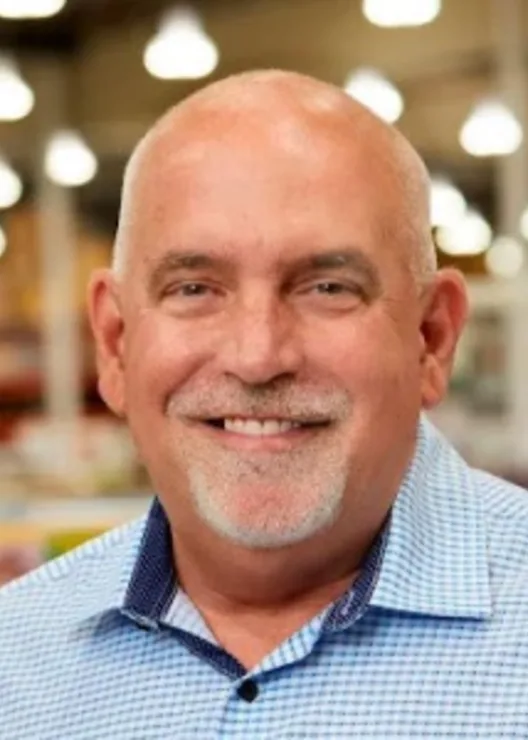
1. Business Role
Vachris is not an outsider brought in to transform Costco into a different kind of company.
He is a career operator shaped inside Costco.
His progression from forklift driver through warehouse operations, merchandising, real estate, COO and CEO is important because it means his leadership is rooted in the operating details of the existing model. [S15]
The central challenge is:
How do you modernize and scale a successful model without destroying the operating discipline that made it successful?
The business role is therefore:
The strategic question is continuity versus adaptation.
2. The Business He Inherited
When Vachris became CEO in January 2024, Costco was already one of the largest retailers in the world.
The inherited model had:
membership
+
low-price merchandise
+
limited assortment
+
rapid inventory turnover
+
Kirkland Signature
+
global warehouses
+
ancillary services
By the end of fiscal 2024 Costco operated 890 warehouses. [S1]
The model was not broken.
The strategic problems were different:
Growth
How do you keep adding warehouses when the best sites in mature markets become harder to secure?
Digital
How do you add delivery, app functionality and online convenience without turning Costco into a high-cost e-commerce retailer?
Supply chain
How do you protect low prices when tariffs, currency, geopolitics and manufacturing concentration change product costs?
Private label
How far can Kirkland penetration grow without weakening national-brand choice?
Scale
How do you preserve employee and member culture across nearly 1,000 warehouses?
3. Business Thesis
Thesis 1 — Preserve the original value equation
Vachris's 2025 annual-report letter emphasizes increased member value rather than a change in Costco's mission. [S16]
Business implication
Do not modernize by abandoning:
low prices
limited SKUs
high productivity
member trust
Where it shows up
- pricing discipline;
- global buying;
- SKU productivity;
- renewal focus.
Thesis 2 — Use limited assortment more dynamically
Vachris highlighted the ability to adjust a limited SKU base toward the most productive merchandise. [S16]
Business implication
The fewer-SKUs model becomes more useful, not less useful, at global scale if buyers continuously remove weak items and concentrate volume.
Where it shows up
global buying teams
supplier negotiations
in-country production
merchandise productivity
Thesis 3 — Invest in Kirkland and digital without changing Costco's identity
Vachris identified Kirkland Signature and digital capabilities as long-term investment areas. [S16]
Business implication
Modernization happens around the warehouse flywheel rather than replacing it.
Where it shows up
- app improvements;
- inventory lookup;
- digital wallet / payment functions;
- Same-Day;
- fast digitally-enabled sales growth;
- Kirkland investment.
Thesis 4 — Global scale requires local sourcing and supply resilience
Vachris described global buying teams working on in-country production and supply-chain efficiency. [S16]
Business implication
A global retailer cannot simply import the exact same supply chain into every country.
Local production can reduce:
- freight;
- currency exposure;
- tariff exposure;
- lead times.
4. Strategic Bets
Strategic Bet 1 — Keep opening warehouses
THE PROBLEM
Costco is already dense in parts of North America.
THE BET
Continue physical expansion in mature and international markets.
THE MECHANISM
Each productive warehouse adds:
members
sales
buying volume
local convenience
THE RISK
New warehouses can:
- open below mature profitability;
- cannibalize nearby locations;
- require expensive real estate.
Costco discloses those risks directly. [S1]
THE RESULT
Warehouse count rose from 890 at fiscal 2024 year-end to 914 at fiscal 2025 year-end and 939 by September 2026. [S1][S2]
THE BUSINESS IMPACT
Physical scale remains a primary growth engine.
ATTRIBUTION
Leadership-level
Strategic Bet 2 — Raise membership fees without weakening renewal
THE PROBLEM
Membership pricing had remained unchanged in the U.S. and Canada since 2017.
THE BET
Raise Gold Star / Business fees from $60 to $65 and Executive from $120 to $130 in September 2024. [S8]
THE MECHANISM
More fee revenue can support investment and operating costs while maintaining low merchandise prices.
THE RISK
A higher fee raises the member's required value threshold.
THE RESULT
By Q3 2026 paid memberships reached 82.9M, while U.S./Canada renewal remained 92.2%. [S4]
THE BUSINESS IMPACT
The membership engine continued growing despite the price increase.
ATTRIBUTION
Company event during Vachris's leadership
Approved sources do not establish the fee increase as his individual decision.
Strategic Bet 3 — Increase Kirkland investment
THE PROBLEM
Inflation, tariffs and supplier costs can pressure member value.
THE BET
Increase investment in Kirkland Signature and private-label penetration. [S16]
THE MECHANISM
Private label gives Costco more control over:
- sourcing;
- specification;
- price;
- margin.
THE RISK
Over-expansion or quality failure can damage one umbrella brand across many categories.
THE RESULT
Costco continues to state that it expects private-label penetration to increase. [S1]
THE BUSINESS IMPACT
Kirkland becomes a larger tool for defending value and differentiation.
Strategic Bet 4 — Add digital convenience without abandoning warehouse economics
THE PROBLEM
Consumers expect:
- delivery;
- online inventory visibility;
- mobile convenience.
THE BET
Invest in digital shopping while keeping physical warehouses central.
THE MECHANISM
Digital can reduce friction without requiring Costco to duplicate the full economics of a pure e-commerce retailer.
THE RISK
Costco says e-commerce has lower gross-margin percentage than warehouse operations. [S1]
THE RESULT
Digitally-enabled comparable sales grew more than 20% in Q3 fiscal 2026. [S3]
THE BUSINESS IMPACT
Digital became a fast-growing access layer around the physical membership system.
Strategic Bet 5 — Globalize buying while localizing supply where useful
THE PROBLEM
A global retailer faces:
- tariffs;
- currency movement;
- logistics risk;
- local taste differences.
THE BET
Use global buying teams while increasing in-country production and supply-chain efficiency. [S16]
THE MECHANISM
Costco can combine global volume with local sourcing flexibility.
THE RISK
More sourcing complexity can challenge quality and consistency.
THE RESULT
International operations continue expanding and contributed 27% of net sales and 34% of operating income in fiscal 2025. [S1]
5. How Those Bets Changed the Business
Product
warehouse merchandise
↓
warehouse + stronger Kirkland + digital access + services
Customer
large mature membership base
↓
larger global base + higher Executive penetration
Revenue logic
The core remains unchanged:
merchandise volume
+
membership fees
But more member interactions now occur through digital channels.
Distribution
warehouse
↓
warehouse + e-commerce + Same-Day + app
Moat
price + membership
↓
price + membership + Kirkland + digital convenience + global scale
Industry position
Costco remains a membership warehouse retailer rather than repositioning into a general technology or advertising platform.
That continuity is itself strategic.
6. Resource Allocation
New warehouses
Physical expansion remains capital intensive and central.
Kirkland Signature
Vachris has explicitly identified Kirkland as a long-term investment area. [S16]
Digital
Costco is investing in app and digitally-enabled capabilities without claiming digital replaces the warehouse.
Employees
Costco raised its starting U.S. hourly wage to at least $20 in 2025 and disclosed average U.S. hourly wages around $32. [S1]
Supply chain
Global buying, in-country production and logistics efficiency are explicit management priorities. [S16]
7. Business Model: Before vs After
The comparison is intentionally subtle because Vachris inherited a strong model.
Costco entering 2024
Core value Low-priced quality merchandise for paid members.
Primary channel Warehouse.
Private label Major strategic asset.
Digital Growing complement.
Scale 890 warehouses by fiscal 2024 year-end.
Costco in September 2026
Core value Still low-priced quality merchandise for paid members.
Primary channel Still warehouse-centered.
Private label Explicit long-term investment priority.
Digital Growing >20% on digitally-enabled comparable-sales measures in recent periods.
Scale 939 warehouses and fiscal 2026 net sales of $297.247B. [S29]
The business model changed less than the scale and execution layers around it.
8. What Worked / What Didn't
WHAT WORKED — Membership growth through a fee increase
What happened
Membership pricing increased in 2024 while member counts continued rising.
Capability created
More fee revenue without a collapse in renewal.
WHAT WORKED — Digitally-enabled growth
What happened
Digitally-enabled comparable sales grew at more than 20% in Q3 2026. [S3]
Capability created
A faster digital convenience layer around the warehouse model.
WHAT WORKED — Continued warehouse expansion
What happened
Costco added locations across the U.S. and international markets.
Capability created
More local member access and aggregate buying volume.
CONSTRAINT — Online memberships renew slightly less often
Costco disclosed that a higher mix of memberships sold online and through digital promotions has modestly pressured reported renewal rates because those memberships renew at a slightly lower rate on average. [S4]
What this reveals
Digital acquisition can expand the funnel without producing exactly the same customer quality as the traditional membership base.
CONSTRAINT — Digital convenience can carry lower margin
Costco says e-commerce has lower gross-margin percentage than warehouse operations. [S1]
What this reveals
Convenience has a cost.
The strategic challenge is to add digital usefulness without destroying warehouse economics.
9. Business Legacy
Vachris's final legacy cannot be known while he is still CEO.
The structural direction so far is:
preserve the membership model
while
scaling warehouses
+
strengthening Kirkland
+
adding digital convenience
+
globalizing sourcing
The notable feature is not a dramatic strategic pivot.
It is disciplined evolution.
Costco under Vachris is trying to become more digital and more global without becoming less Costco-like.
Career Background
Costco's succession announcement says Vachris started as a forklift driver and spent more than 40 years at the company before becoming CEO. [S15]
He later held major roles across:
- warehouse operations;
- regional management;
- real estate;
- merchandising;
- chief operating officer duties.
That path is unusually aligned with Costco's promote-from-within culture.
Career Timeline
Begins Costco career, including work as a forklift driver.
Regional / operating leadership roles.
Senior Vice President, Real Estate Development.
Executive Vice President, Merchandising.
Becomes President and Chief Operating Officer.
Becomes President and CEO. [S15]
Costco ends fiscal year with 914 warehouses and $269.9B net sales. [S1]
Warehouse count reaches 939; fiscal-year net sales reach $297.247B. [S29]
Common Misconceptions
"Ron Vachris was hired from outside to modernize Costco."
No.
He is a long-tenured Costco operator who rose through the organization.
"His strategy is to turn Costco into an e-commerce company."
No evidence in the approved sources supports that characterization.
Digital is being added around the warehouse model.
"The current Costco strategy abandoned limited SKUs."
No.
Vachris's 2025 letter explicitly praises the productivity benefits of the limited-SKU model. [S16]
"Every recent Costco change is Vachris's personal decision."
No.
Fee changes, warehouse openings, product decisions and digital projects are company decisions involving teams, the board and operating management.
Evidence
- CEO succession and 40+ year Costco career: 2023 succession announcement. [S15]
- Limited-SKU, Kirkland, digital and supply-chain priorities: FY2025 annual report letter. [S16]
- Current member, digital and margin data: Q3 FY2026 disclosures. [S3][S4]
- Fiscal 2026 financial results and warehouse scale: Q4 and fiscal 2026 results. [S29]