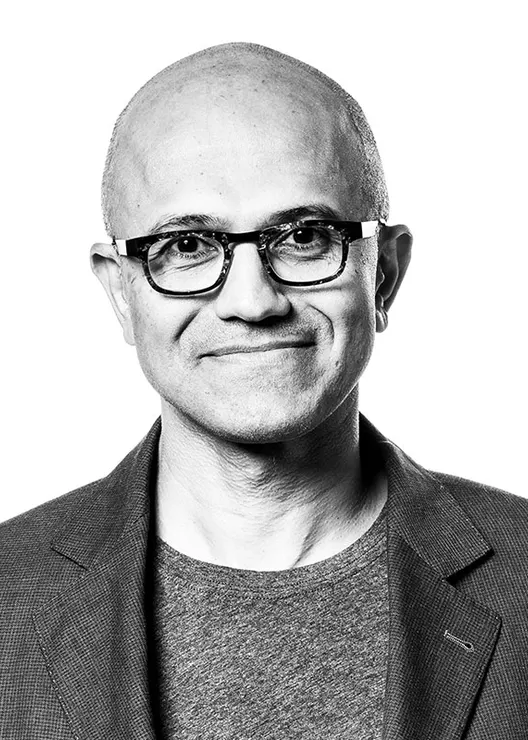
1. Business Role
That allowed the company to build a new center around:
subscriptions
+
developers
+
cross-platform software
+
AI
while keeping Windows as a valuable endpoint rather than the sole organizing platform.
Nadella's role can be described as:
cloud platform builder
+
business-model transformer
+
portfolio integrator
He did not inherit a broken company.
Microsoft already had:
- Windows;
- Office;
- Server products;
- Xbox;
- enterprise customers;
- major cash flow.
The strategic issue was that the computing market had changed.
Cloud services, mobile devices and open-source software were reducing the ability of Windows alone to define where software ran.
Nadella's importance is that Microsoft changed what it optimized around.
2. The Business He Inherited
Microsoft in early 2014 still had several structural strengths.
Existing assets
Windows installed base
Office installed base
enterprise sales force
server software
developer tools
cash / balance sheet
global partner network
Emerging asset
Azure already existed and Nadella had led the Cloud and Enterprise business. [S7][S8]
Strategic constraints
Microsoft's traditional model had been built around:
Windows
↓
applications
↓
PC ecosystem
But new growth was moving toward:
- cloud;
- iOS / Android;
- browser-based software;
- open-source infrastructure.
The key business question was:
Should Microsoft keep protecting Windows as the center of every platform decision, or make Microsoft services valuable wherever customers choose to compute?
The company's later actions strongly support the second direction.
3. Business Thesis
These theses are supported by Microsoft's long-term actions under Nadella rather than treated as guesses about private intent.
Thesis 1 — Cloud can become Microsoft's new platform center
Business implication
Invest aggressively in Azure and move server / enterprise workloads to cloud services.
Where it showed up
- Azure expansion;
- hyperscale datacenters;
- cloud databases;
- AI infrastructure;
- Microsoft Cloud.
The result was a shift from software licenses running on customer hardware toward Microsoft-operated infrastructure.
Thesis 2 — Microsoft services should win even when Windows is not the device platform
Business implication
Make key products available across:
- iOS;
- Android;
- Linux;
- macOS;
- web.
Where it showed up
- Office on competing platforms;
- Azure support for Linux;
- GitHub acquisition;
- open-source participation.
This weakened Windows exclusivity as a strategic rule while expanding Microsoft's addressable market.
Thesis 3 — Recurring cloud relationships are more valuable than periodic upgrade cycles
Business implication
Shift products toward:
- Microsoft 365 subscriptions;
- Dynamics cloud;
- Azure consumption.
Where it showed up
The revenue model changed from:
license
→
wait for upgrade
to:
subscription / usage
→
continuous relationship
Thesis 4 — Developers matter regardless of platform allegiance
Business implication
Own important developer workflows without requiring Windows exclusivity.
Where it showed up
- GitHub;
- Visual Studio Code;
- Azure;
- open-source support;
- GitHub Copilot.
GitHub gave Microsoft a developer relationship much broader than the Windows ecosystem.
Thesis 5 — AI should become a layer across Microsoft's existing distribution
Business implication
Do not build AI as one isolated application.
Put it into:
- Microsoft 365;
- GitHub;
- Dynamics;
- Security;
- Azure;
- Windows / Copilot.
Where it showed up
Copilot and agent products across Microsoft's portfolio.
4. Strategic Bets
Strategic Bet 1 — Put Azure at the center of future growth
THE PROBLEM
Microsoft's historical licensing model depended heavily on customer-owned infrastructure and PC / server upgrade cycles.
THE BET
Build a global hyperscale cloud.
THE MECHANISM
customer moves workload to Azure
↓
Microsoft earns recurring / consumption revenue
↓
customer adds data / security / AI services
↓
relationship expands
THE RISK
Datacenters require enormous capital, and Microsoft competes with other hyperscale providers.
THE RESULT
Azure surpassed $100 billion in annual revenue in FY2026. [S2]
THE BUSINESS IMPACT
Microsoft became both a software vendor and a massive infrastructure operator.
Strategic Bet 2 — Make Office a cloud subscription
THE PROBLEM
Perpetual Office releases created long and uneven upgrade cycles.
THE BET
Move productivity to Office 365 / Microsoft 365.
THE MECHANISM
continuous cloud service
↓
recurring seat revenue
↓
more services added
↓
higher customer value / expansion
THE RESULT
Microsoft 365 Commercial products and cloud services generated $101.997 billion in FY2026. [S1]
THE BUSINESS IMPACT
One of Microsoft's largest franchises became recurring.
Strategic Bet 3 — Embrace cross-platform and open-source developer ecosystems
THE PROBLEM
Developers increasingly built on Linux, cloud and non-Windows environments.
THE BET
Compete for developer usage instead of requiring Windows loyalty.
THE MECHANISM
Support multiple operating systems and own important developer workflows.
THE RESULT
Microsoft acquired GitHub in 2018 and GitHub reached 225 million users by FY2026 Q4. [S3][S18]
THE BUSINESS IMPACT
Microsoft's developer relevance became less tied to the PC operating system.
Strategic Bet 4 — Acquire LinkedIn
THE PROBLEM
Microsoft had software accounts but lacked a global professional-identity network.
THE BET
Acquire LinkedIn for $27.0 billion. [S20]
THE MECHANISM
Connect professional identity and economic graph to:
- productivity;
- recruiting;
- sales;
- advertising;
- business applications.
THE RESULT
LinkedIn generated $19.817 billion of FY2026 revenue. [S1]
THE BUSINESS IMPACT
Microsoft added a large network business rather than another conventional enterprise application.
Strategic Bet 5 — Acquire GitHub
THE PROBLEM
Microsoft needed deeper relevance among modern developers and open-source communities.
THE BET
Buy GitHub for $7.5 billion while preserving an open developer platform. [S18][S19]
THE RESULT
GitHub became a core developer surface and later a major AI-coding channel.
THE BUSINESS IMPACT
Developer distribution became an asset independent of Windows.
Strategic Bet 6 — Partner deeply with OpenAI and build Copilot
THE PROBLEM
Generative AI created a new interface and computing workload that could reshape existing software categories.
THE BET
Invest in OpenAI, supply Azure infrastructure, license model IP and distribute AI through Microsoft's products.
THE MECHANISM
model capability
+
Azure
+
Microsoft distribution
=
Copilot products
THE RISK
Heavy compute investment, model dependence, fast competition and uncertain monetization.
THE RESULT
Microsoft 365 Copilot surpassed 30 million paid seats and GitHub Copilot reached 50 million users by FY2026. [S2][S3]
THE BUSINESS IMPACT
AI became a horizontal layer across the portfolio.
Strategic Bet 7 — Build enormous AI infrastructure
THE PROBLEM
AI demand is constrained by physical compute.
THE BET
Commit large amounts of capital to datacenters, GPUs, networks and energy.
THE MECHANISM
Own enough infrastructure to serve Azure and Copilot demand.
THE CONSTRAINT
Microsoft says demand continues to exceed available capacity in some workloads. [S3]
THE BUSINESS IMPACT
Microsoft has become far more capital intensive than its historical software model.
5. How Those Bets Changed the Business
Product
Windows / Office / Server
↓
Azure + Microsoft 365
↓
GitHub + LinkedIn + Security
↓
Copilot / AI across stack
Customer
Earlier Microsoft:
PC user
enterprise IT
OEM
Microsoft in 2026:
employee
enterprise
developer
advertiser
gamer
cloud startup
AI builder
Revenue logic
license
↓
subscription
↓
consumption
↓
seat + AI consumption
Distribution
OEM / packaged software
↓
cloud direct sales + enterprise agreements
↓
GitHub / app stores / web / partner ecosystem
Moat / competitive position
The advantage increasingly comes from connected distribution across:
identity
productivity
cloud
developer tools
security
business applications
AI
rather than one dominant desktop platform.
6. Resource Allocation
Nadella-era strategy is visible in where Microsoft committed resources.
Datacenters
Cloud and AI require huge infrastructure investment.
Acquisitions
Major transactions include:
- LinkedIn;
- GitHub;
- Activision Blizzard.
AI partnerships
Microsoft committed capital and cloud infrastructure to OpenAI.
Internal AI development
Microsoft now develops its own MAI models and supports multiple model providers. [S3]
Developer ecosystem
GitHub, Visual Studio Code and open-source support broadened Microsoft beyond Windows development.
The resource pattern is consistent:
Build or acquire the platform layers that control future workload distribution.
7. Business Model: Before vs. After
| Dimension | Microsoft before Nadella | Microsoft in 2026 |
|---|---|---|
| Strategic center | Windows / Office / Server | Azure + Microsoft 365 + AI + developer ecosystem |
| Revenue | License-heavy | Subscription + consumption + licensing |
| Infrastructure | Customer server | Microsoft datacenter |
| Device philosophy | Windows-first | Cross-platform |
| Developer relationship | Windows / .NET-centered | GitHub + open source + Azure |
| Productivity | Office upgrade | Microsoft 365 recurring |
| AI | Research / embedded features | Copilot / agents across products |
| Capital intensity | Software-heavy | Datacenter / AI infrastructure-heavy |
| Acquisition logic | Product / category | Networks, developers, content |
8. What Worked / What Didn't
WHAT WORKED — Azure
Azure became one of Microsoft's largest economic engines.
WHAT WORKED — Microsoft 365 subscription transition
Office moved into a large recurring cloud business.
WHAT WORKED — GitHub / open developer ecosystem
Microsoft expanded developer reach far beyond Windows-only development.
WHAT WORKED — LinkedIn
LinkedIn became a large independent revenue engine.
CONSTRAINT — Cloud and AI now require enormous capital
The business is more recurring but also more infrastructure intensive.
Microsoft must build before all future demand is certain.
CONSTRAINT — Capacity can limit growth
Microsoft said AI / cloud demand continues to exceed available capacity in some areas. [S3]
CONSTRAINT — AI partnership concentration had to become more flexible
The OpenAI partnership remains strategically important, but the April 2026 amendment made Microsoft's IP license non-exclusive and the broader product stack increasingly multi-model. [S24]
This is better understood as diversification of AI supply rather than a simple abandonment of the partnership.
9. Business Legacy
Nadella's structural impact on Microsoft can be summarized as:
Windows-centered platform
→
cloud-centered portfolio

license cycle
→
recurring subscription / consumption

Windows developer
→
cross-platform developer

application features
→
AI agents / Copilot

software company
→
software + global computing infrastructure
The company did not discard its old assets.
It redefined how they fit together.
Career Background
Nadella joined Microsoft in 1992 and held leadership roles across enterprise and online-services businesses.
Before becoming CEO, he led Microsoft's Cloud and Enterprise group, which put him close to the business that later became Microsoft's main growth engine. [S7][S8]
Career Timeline
Joins Microsoft. [S7]
Leads major server / cloud businesses.
Becomes CEO. [S8]
Microsoft completes LinkedIn acquisition.
Microsoft acquires GitHub.
OpenAI relationship, Azure AI and Copilot expand.
Becomes Microsoft chairman.
Activision Blizzard acquisition closes.
Azure crosses $100 billion annual revenue; Microsoft 365 Copilot exceeds 30 million paid seats. [S2]
Common Misconceptions
"Nadella killed Windows."
No.
Windows remained strategically relevant; Microsoft stopped requiring Windows to be the center of every growth opportunity.
"Nadella personally created Azure."
No.
Azure existed before he became CEO. He inherited and accelerated a cloud business he had previously helped lead.
"The cloud shift made Microsoft asset-light."
No.
It made Microsoft much more physically capital intensive.
"Microsoft's AI strategy is just OpenAI."
No.
OpenAI is important, but Microsoft also develops internal models and supports other model providers.
Evidence
- Nadella joined Microsoft in 1992 and led Cloud and Enterprise before becoming CEO. [S7][S8]
- Azure surpassed $100 billion annual revenue in FY2026. [S2]
- Microsoft 365 Commercial products and cloud services generated $101.997 billion in FY2026. [S1]
- Microsoft acquired LinkedIn and GitHub during Nadella's tenure. [S18][S20]
- Microsoft 365 Copilot exceeded 30 million paid seats. [S2]
- Microsoft is investing heavily in AI and cloud infrastructure. [S1][S3]