1. Business Role
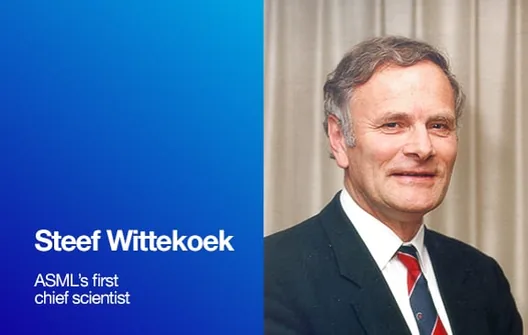
Wittekoek connected research knowledge with a product that had to survive outside a laboratory. His work concerned the early wafer steppers, particularly alignment and the development from PAS 2000 to PAS 2500. ASML's official account directly associates him with those activities. [S25]
Alignment is a commercial issue as well as a technical one. A chip contains multiple patterned layers. Producing one clear image is insufficient if later layers miss the structures beneath them. Customers need repeatable placement across wafers and over time.
For an early supplier, solving that problem helped turn scientific competence into a reason for customers to buy.
2. The Business He Helped Start
ASML began as a Philips and ASM International joint venture. It inherited research and technology, but not a secure market position. Established suppliers already had products and customer relationships. The new company needed operating funds, a stronger machine and a convincing reason for customers to accept the risk of switching. [S21][S22]
Its first commercial challenge was not EUV or geopolitical importance. It was obtaining enough production credibility to remain in business. That distinction matters when evaluating Wittekoek: later ASML capabilities should not be projected backward onto an early scientist's role.
The company also lacked the scale to reproduce every specialist capability internally. Its technology choices therefore had to work with a network of partners.
3. Business Thesis
Accuracy had to become a usable product capability
Wittekoek's documented alignment work supports a clear business interpretation: an early lithography supplier needed dependable performance, not just a novel optical concept. Better alignment expanded the conditions under which a customer could use the equipment. [S25]
This is an explanation of the work's commercial mechanism, not a claim to know his private motivation. The evidence supports the technical contribution and its place in product development.
Specialist collaboration could extend a small company's reach
His role in the ZEISS partnership provided an early example of obtaining frontier expertise through collaboration rather than owning every activity. ASML dates the formal optics relationship to 1986. [S21][S25]
The implication was organizational. A small company could pursue an ambitious product if it defined interfaces and worked closely with a capable specialist. It still had to manage the resulting dependence.
4. Strategic Bets
Improve the platform rather than discard the starting point
Wittekoek led the team that developed PAS 2000 into PAS 2500. That choice built on inherited capability while addressing the limitations that held back competitiveness. [S25]
The business problem was time: a company with limited resources could not indefinitely fund a completely new machine while existing products failed to earn customer acceptance. An improved platform offered a route from research to sales.
The risk was that incremental improvement might still be insufficient against established suppliers. The PAS 2500 was therefore one stage in building credibility, not a complete explanation of ASML's later leadership.
Make alignment a source of customer value
The alignment system connected optical projection with actual feature placement. A customer buying a stepper was buying the ability to reproduce a manufacturing process, not simply an optical instrument. [S25]
That made accuracy useful through yield and process consistency. A machine that reduced errors could protect customer output. The technical contribution mattered because it operated inside that economic relationship.
Establish a lasting optics collaboration
Working with ZEISS created access to specialized optical development while ASML retained the system-integration role. The arrangement required coordination over specifications, development timing and later product needs. [S21][S25]
The result was an early relationship that subsequent leadership teams extended. It would overstate the evidence to say Wittekoek designed the terms or architecture of later High-NA programs. His documented role concerns the early partnership, not every future investment.
5. How Those Bets Changed the Business
The product changed from an inherited starting point toward more competitive production equipment. Customer trust could begin to rest on improved alignment and usable performance rather than the reputation of the founding organizations alone.
The company boundary also took shape. ASML did not need to become a complete optics manufacturer to sell a sophisticated lithography system. It could coordinate a specialist supplier while contributing alignment, architecture and integration.
This approach created a potential path to scale, but not an immediate escape from financial weakness. ASML's difficult late-1980s and early-1990s history shows that technical progress and commercial survival were distinct problems. [S21]
6. Resource Allocation
Wittekoek's documented role concerns technical effort, not corporate capital allocation. It is therefore more accurate to examine engineering priorities than attribute financing decisions to him.
Early teams had to direct limited resources toward accuracy, productivity and a working product. Specialist collaboration could avoid attempting to duplicate every optical capability internally, while concentrating ASML effort on system integration and customer requirements.
That did not eliminate development costs. It changed where knowledge and responsibility sat. A partner could supply expertise, but ASML still had to integrate the contribution and support the machine. Financing support from Philips and later executive decisions belong to other actors in the company's history. [S21][S22]
7. Business Model: Before vs. After
| Dimension | At the 1984 starting point | Contribution during the early development period |
|---|---|---|
| Product foundation | Inherited stepper research and PAS 2000 | Development toward the more capable PAS 2500 |
| Customer proposition | A young supplier with much to prove | Better alignment and production credibility |
| Optics capability | Need for specialist collaboration | A developing ZEISS relationship |
| Internal focus | Convert research into equipment | Strengthen accuracy and system integration |
| Remaining constraint | Survival and market acceptance | Still needed customers, funding and later platform success |
The table describes his contribution, not a claim that the company was financially secure by the end of one product project.
8. What Worked / What Didn't
Alignment and optical collaboration became lasting capabilities in ASML's development. They helped establish an organizational pattern that later leaders could reuse. [S25]
They were not sufficient on their own. ASML still needed the PAS 5500 breakthrough, customers willing to qualify its equipment and financial support through difficult conditions. Those later events demonstrate the boundary of an early technical contribution. [S21]
His documented record is strongest on early product development. Later company setbacks cannot automatically be assigned to his decisions. The central limitation was that a better machine did not immediately create a durable business.
9. Business Legacy
Wittekoek's legacy is an early bridge between scientific knowledge, product accuracy and specialist collaboration. It helps explain why ASML became a system integrator rather than a company that manufactured every critical component itself.
Later EUV leadership was not an outcome he independently delivered. It required decades of work after the early platform and partnership decisions. His contribution is significant precisely when kept within its documented scope: helping a vulnerable new company build technical foundations that others could extend.
Career Timeline
Before 1984 — Philips Research
Works on early wafer-stepper technology. [S25]
1984 — First Chief Scientist
Joins the new ASML organization and leads important early development work. [S25]
1986 — PAS 2500 and optics partnership
Company history records the improved stepper and the established ZEISS relationship. [S21]
1998 — Retirement
Ends his ASML career before the later production-EUV era. [S25]
Common Misconceptions
Wittekoek created ASML alone
ASML was a joint venture, and product development involved teams, founding organizations and suppliers.
Early open collaboration meant ASML had no proprietary capability
System design, alignment and integration could remain differentiated even when an external specialist supplied optics.