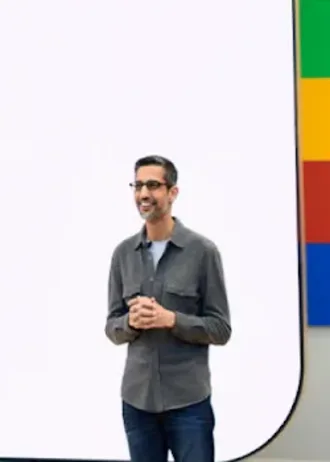
1. Business Role
Pichai's role is unusual because Alphabet contains businesses with very different economics.
He must simultaneously manage:
Android / Chrome / Maps / Play
consumer subscriptions
Google Cloud
Gemini / DeepMind
Other Bets such as Waymo
The CEO is therefore not simply running one product portfolio.
He is allocating capital across several business models and time horizons.
2. The Business He Inherited
When Pichai became Google CEO in 2015, the company already had:
- dominant Search economics;
- Android scale;
- Chrome distribution;
- YouTube;
- Maps;
- early Cloud operations;
- strong AI research.
But several major businesses were much less mature than they are today.
Google Cloud was far smaller.
YouTube subscriptions were less developed.
Generative AI had not yet reset the competitive environment.
3. Business Thesis
Pichai repeatedly described Google as an AI-first company beginning in 2016. [S1]
The thesis evolved through several stages.
Stage 1 — AI improves existing products
better ranking
better recommendations
better translation
better photos
better ads
Stage 2 — AI becomes a platform
TPUs
Cloud AI
APIs
DeepMind / Brain research
Stage 3 — AI becomes the user interface
Gemini App
AI Overviews
AI Mode
Gemini in Workspace
Gemini in Android / Chrome / YouTube
Pichai's current strategy is to connect all three layers.
4. Strategic Bets
Search must expand through AI rather than defend the old interface
Generative AI could have been treated as a threat to Search.
Google instead rebuilt Search around AI Overviews and AI Mode.
The strategic goal is not to preserve ten blue links.
It is to preserve Google's role as the place where people ask for information.
Cloud must become a major business
Google had extraordinary internal infrastructure but historically monetized it less successfully than Amazon or Microsoft monetized enterprise cloud.
Under Pichai, Cloud received sustained investment.
By 2025 it produced $58.7B of revenue and $13.9B of operating income. [S1]
By Q2 2026, quarterly Cloud revenue reached $24.8B. [S2]
AI must have one stronger organizational center
In 2023 Google combined the Google Brain team and DeepMind into Google DeepMind. [S22]
That reduced fragmentation between two leading internal AI research groups.
Gemini became the flagship model family later that year.
Distribution is a competitive asset
Pichai's earlier product career included Chrome and Android.
That experience matters in the AI era because Google can distribute Gemini across:
Search
Android
Chrome
YouTube
Workspace
Cloud
The competitive advantage is not only model quality.
It is model quality multiplied by distribution.
Other Bets still matter
Pichai did not eliminate Alphabet's long-duration structure.
Waymo, in particular, has moved into commercial scale.
Alphabet's 2026 proxy even introduced performance-based compensation elements tied to Waymo and Wing, reinforcing Pichai's responsibility for the portfolio. [S5]
5. How Those Bets Changed the Business
Before
Search / ads dominate
Cloud small
AI mostly invisible inside products
Other Bets mostly experimental
By 2026
Search still dominates
+
Cloud is a major profit engine
+
AI is visible in the product interface
+
Gemini spans consumer and enterprise
+
Waymo is commercially scaling
The company is broader without abandoning the original economics.
6. Resource Allocation
The largest shift is infrastructure intensity.
Alphabet capex rose to $91.4B in 2025 and the company planned a significant further increase in 2026. [S1]
That reflects a strategic choice:
spend aggressively on compute now
↓
build AI capacity
↓
defend Search + grow Cloud + distribute Gemini
This is one of the highest-stakes capital-allocation decisions in Alphabet's history.
7. Business Model: Before vs. After
EARLIER GOOGLE
Search
↓
advertising
↓
free consumer services

PICHAl-ERA ALPHABET
Search + YouTube
↓
advertising
+
Cloud + Workspace + Gemini Enterprise
↓
enterprise consumption / subscriptions
+
consumer subscriptions
+
Other Bets commercialization
The business did not replace advertising.
It layered new engines on top.
8. What Worked / What Didn't
What worked
- Cloud moved to large-scale profitability.
- Search continued growing during the generative-AI transition.
- YouTube expanded into subscriptions and TV.
- Gemini achieved rapid consumer distribution.
- Waymo reached meaningful commercial scale.
What remains unresolved
- AI infrastructure is extremely capital intensive.
- Search must balance generated answers with the web ecosystem.
- regulation may change distribution and ad-tech structure;
- not every Other Bet has become a sustainable business;
- model competition remains intense.
This is why Pichai's legacy is still being written.
9. Business Legacy
Pichai's likely long-term legacy will depend on one question:
Did Google successfully move from being the company that organized the web to being the company that organizes information and action through AI?
The answer will be determined across Search, Cloud and Gemini rather than one product.
Career Background
Pichai joined Google in 2004.
He became closely associated with:
- Google Toolbar;
- Chrome;
- Chrome OS;
- Android;
- broader Google product leadership.
He became Google CEO in 2015 when Alphabet was created.
He became Alphabet CEO in 2019 after Larry Page and Sergey Brin stepped back from daily management. [S30]
Career Timeline
2004   joins Google
2008   Chrome launches during his product leadership era
2013   assumes Android leadership
2015   becomes Google CEO
2019   becomes Alphabet CEO
2023   Google DeepMind formed
2023   Gemini introduced
2026   AI + Cloud infrastructure become central capital priorities
Common Misconceptions
“Pichai replaced the founders entirely.”
Larry Page and Sergey Brin remain co-founders, major shareholders and directors. Pichai runs day-to-day Alphabet and Google operations. [S5][S6]
“His strategy is only AI.”
AI is the connective layer, but the operating system includes Search, advertising, subscriptions, Cloud and Other Bets.
“Alphabet stopped moonshots under Pichai.”
No. Waymo and other Bets continue to receive substantial investment.
Evidence
S1  Alphabet FY2025 Form 10-K
S2  Q2 2026 Results
S5  2026 Proxy
S7  Q2 CEO remarks
S22 Google DeepMind formation
S23-S24 Wiz
S30 founders' management transition