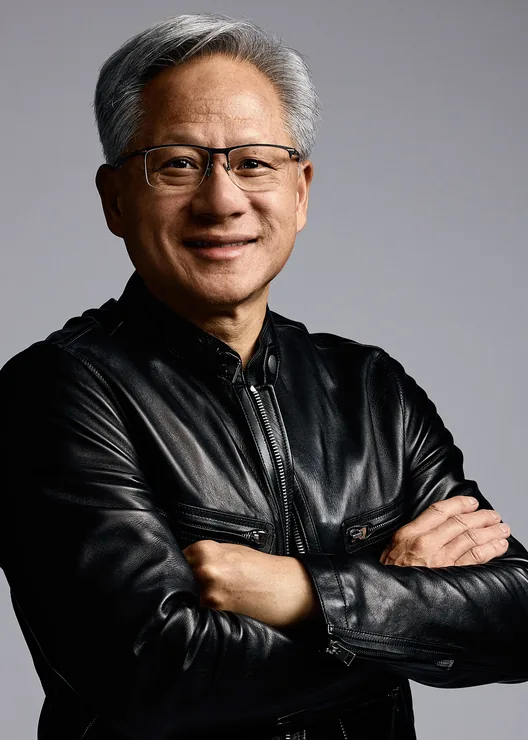
1. Business Role
Huang's business role is broader than "founder" and more specific than "technology executive."
He has occupied four overlapping roles at NVIDIA:
The most unusual part is the duration.
NVIDIA did not remain the same business for more than three decades. During Huang's tenure, the company moved through several distinct phases:
That makes Huang relevant to BizTear for one reason above all:
The company's business identity changed several times while its top executive did not.
This does not mean every NVIDIA product or technical breakthrough should be attributed to Huang personally.
NVIDIA's products were created by large engineering, software, product, operations and partner ecosystems.
The useful question is where Huang's leadership can be connected to the direction, resource allocation and business architecture of the company.
2. The Business Huang Helped Start
NVIDIA in 1993 was a very different business from NVIDIA in 2026.
The original market
The company was founded around the opportunity in 3D graphics for gaming and multimedia.
The basic commercial logic was straightforward:
PC graphics become more demanding
↓
general-purpose CPUs are not ideal for every graphics task
↓
specialized graphics processors become more valuable
↓
sell graphics hardware into the PC ecosystem
The original customer context
NVIDIA's early world was centered on:
- PC manufacturers;
- graphics-card companies;
- game developers;
- gamers;
- multimedia software.
The original value proposition
The company was trying to make computer graphics faster and more capable.
That is very different from today's value proposition around:
- AI training;
- AI inference;
- cloud infrastructure;
- networking;
- full-stack systems;
- simulation;
- robotics.
The original revenue logic
At a high level, the early business depended on selling graphics hardware into the PC market.
NVIDIA had not yet built the broader stack that defines it today.
What did not exist yet
In 1993 NVIDIA did not have:
CUDA
DGX
Mellanox inside NVIDIA
Blackwell
Rubin
large-scale AI infrastructure
enterprise AI software
modern data-center networking
This starting point matters because it shows the scale of the later business transformation.
3. Business Thesis
A serious business profile should not guess an executive's private intentions.
But Huang has repeatedly expressed strategic ideas publicly, and NVIDIA's long-term behavior provides evidence of how those ideas were translated into business.
Four recurring theses are especially important.
Thesis 1 — Not every workload should run on general-purpose computing alone
Huang has repeatedly framed NVIDIA around accelerated computing.
The basic idea is that specialized processors can execute some workloads much more efficiently than relying entirely on general-purpose CPUs.
Business implication
If more workloads can benefit from acceleration, NVIDIA's market can expand beyond graphics.
Where it showed up
Graphics
↓
Scientific computing
↓
HPC
↓
Deep learning
↓
Generative AI
↓
Physical AI
What this means
The long-term business opportunity was not merely "sell faster GPUs."
It was:
Increase the number of important computing workloads that need accelerated hardware.
Thesis 2 — Hardware without software is not enough
A specialized processor has limited commercial value if developers cannot use it easily.
NVIDIA's long investment in CUDA, libraries, SDKs and developer tools reflects a second thesis:
A computing platform needs software as much as hardware.
Business implication
Invest in a software ecosystem that makes the hardware useful across generations.
Where it showed up
- CUDA;
- CUDA-X libraries;
- AI frameworks;
- development tools;
- optimized software stacks.
What this means
A hardware generation becomes obsolete.
A software ecosystem can persist across many hardware generations.
That changes the competitive structure of the business.
Thesis 3 — The unit of competition gets larger as AI scales
When one GPU runs one workload, the processor can be the center of attention.
When thousands of accelerators work together, the system becomes the product.
Business implication
Expand from:
GPUto:
GPU
+ CPU
+ interconnect
+ networking
+ system
+ software
Where it showed up
- DGX;
- Mellanox;
- NVLink;
- InfiniBand;
- Blackwell;
- Rubin.
What this means
NVIDIA increasingly competes by designing how a whole computing system works, not just how fast one chip runs.
Thesis 4 — Control more of the architecture without owning every factory
NVIDIA remains a fabless company.
It relies on outside foundries, memory suppliers and contract manufacturers.
At the same time, the company has expanded its architectural control.
Business implication
Own more of:
Compute design
Networking design
System design
Software
Developer platform
while outsourcing much of:
Wafer fabrication
Memory manufacturing
Assembly
Packaging
Large parts of physical production
What this means
Huang-era NVIDIA did not become more vertically integrated by building everything itself.
It became more architecturally integrated while remaining heavily dependent on an external manufacturing ecosystem.
4. Strategic Bets
The most useful way to analyze Huang is not by listing "achievements."
It is to examine major strategic bets and ask:
What problem was NVIDIA trying to solve?
What did it bet on?
How was the bet supposed to work?
What was the risk?
What happened?
How did it change the business?
Strategic Bet 1 — Build around specialized graphics processing
THE PROBLEM
PC graphics were becoming more demanding.
General-purpose computing alone was not the most efficient way to handle increasingly complex 3D graphics.
THE BET
Build a company around specialized graphics processing.
THE MECHANISM
If 3D graphics became central to gaming and multimedia, demand for specialized graphics hardware could grow with the PC ecosystem.
THE RISK
Graphics was a fast-moving semiconductor market with uncertain standards and strong competition.
A startup could easily be made irrelevant by a bad architecture choice or platform shift.
THE RESULT
NVIDIA survived and eventually established GeForce as a major consumer graphics family.
THE BUSINESS IMPACT
The graphics business created the hardware and engineering foundation for later parallel computing.
ATTRIBUTION
Directly documented
Huang was one of three co-founders and became CEO at inception.
Strategic Bet 2 — CUDA: turn the GPU into a broader computing platform
THE PROBLEM
NVIDIA's hardware had parallel-processing capability, but demand was still heavily connected to graphics.
Using GPUs for non-graphics workloads was possible but difficult.
THE BET
Invest in a general-purpose GPU computing software platform.
NVIDIA introduced CUDA in 2006.
THE MECHANISM
If programmers could use GPUs for scientific and technical workloads, NVIDIA could expand beyond the graphics market.
The potential addressable market could move from:
graphicsto:
graphics
+ science
+ engineering
+ HPC
+ machine learning
+ AI
THE RISK
CUDA required long-term investment in:
- software;
- compilers;
- libraries;
- developer tools;
- documentation;
- ecosystem support.
At the beginning, no one could guarantee that GPU computing outside graphics would become as commercially important as it later became.
THE RESULT
CUDA became widely used in scientific computing and later became central to NVIDIA's AI software ecosystem.
THE BUSINESS IMPACT
CUDA changed NVIDIA's business in several ways.
Product
GPU
→
GPU + software platform
Customer
gaming / PC
→
developers / researchers / enterprises / AI
Competitive advantage
hardware performance
→
hardware + software + developer ecosystem
Industry position
graphics vendor
→
accelerated-computing platform
ATTRIBUTION
Leadership-level
CUDA was an NVIDIA platform introduced under Huang's leadership.
The available primary sources support associating it with NVIDIA's long-term strategy, but not describing CUDA as Huang's personal invention.
Strategic Bet 3 — DGX: move from component to complete AI system
THE PROBLEM
As deep learning workloads grew, customers needed more than individual GPU cards.
They needed:
- multiple GPUs;
- high-speed interconnects;
- system software;
- integrated software stacks;
- validated configurations.
THE BET
Sell a purpose-built AI computer.
NVIDIA introduced DGX-1 in 2016.
THE MECHANISM
If NVIDIA designed the whole AI system, it could optimize more than the accelerator and capture more of the computing stack.
THE RISK
This moved NVIDIA into territory traditionally occupied by server and systems companies.
It increased responsibility for:
- integration;
- system design;
- software;
- deployment.
THE RESULT
DGX became a broader family of AI systems and infrastructure.
THE BUSINESS IMPACT
NVIDIA expanded from:
component suppliertoward:
system architectThe strategic unit became larger.
ATTRIBUTION
Leadership-level with public strategic explanation
Huang publicly presented DGX-1 as a system built specifically for the emerging AI computing model.
Strategic Bet 4 — Mellanox: make networking part of the computing stack
THE PROBLEM
Large AI and high-performance computing systems require many processors to communicate.
At scale, networking can become a major bottleneck.
THE BET
Acquire Mellanox Technologies.
NVIDIA completed the $7 billion acquisition in 2020.
THE MECHANISM
Combine:
NVIDIA compute
+
Mellanox high-performance networking
to create a broader data-center platform.
THE RISK
This was a major acquisition outside NVIDIA's historic graphics identity.
NVIDIA was betting that networking would become strategically inseparable from accelerated computing.
THE RESULT
Networking became a core part of NVIDIA's data-center architecture through technologies such as:
- InfiniBand;
- Ethernet;
- ConnectX;
- BlueField.
THE BUSINESS IMPACT
The company expanded from:
computetoward:
compute + networkingThat was essential for scaling AI from one server to large clusters.
ATTRIBUTION
Directly documented at the strategic-rationale level
Huang publicly described the combination as bringing together NVIDIA compute and Mellanox networking to build end-to-end data-center technology.
Strategic Bet 5 — Attempt to acquire Arm
THE PROBLEM
NVIDIA was expanding beyond GPUs while Arm architecture was becoming important across:
- cloud;
- edge;
- embedded computing;
- AI;
- robotics.
THE BET
Acquire Arm from SoftBank.
The transaction was announced in 2020 at a proposed value of up to $40 billion.
THE MECHANISM
The deal could have given NVIDIA a much larger role in CPU architecture and computing-platform design.
THE RISK
Arm's value comes partly from serving a broad ecosystem of licensees.
That made ownership by one major computing company highly sensitive from a regulatory and industry-neutrality perspective.
THE RESULT
The acquisition did not close.
NVIDIA and SoftBank terminated the transaction in 2022 because significant regulatory challenges prevented completion.
THE BUSINESS IMPACT
The failed transaction still reveals something important:
NVIDIA wanted to expand its influence across more of the computing architecture.
But it also revealed a hard constraint:
Corporate strategy is limited by regulators, counterparties and industry structure.
ATTRIBUTION
Directly documented
Huang publicly supported the strategic rationale for the transaction and commented on the relationship after termination.
Strategic Bet 6 — Blackwell and Rubin: make the whole data center the product
THE PROBLEM
AI workloads increasingly require:
- enormous compute;
- high-bandwidth memory;
- interconnects;
- networking;
- power;
- cooling;
- software;
- coordinated infrastructure.
Optimizing one GPU is no longer enough.
THE BET
Design full-stack platform generations around data-center-scale computing.
Blackwell pushed NVIDIA deeper into rack-scale AI infrastructure.
Rubin extends the model through co-design across multiple chips and networking components.
THE MECHANISM
If NVIDIA controls the architecture across more layers, it can optimize the total system rather than one component.
THE RISK
The larger the system, the more execution depends on:
- manufacturing capacity;
- supply-chain coordination;
- packaging;
- memory;
- networking;
- OEMs;
- cloud customers;
- power and cooling infrastructure.
THE RESULT
By 2026 NVIDIA was publicly describing itself in infrastructure terms, and Vera Rubin was ramping into full production.
THE BUSINESS IMPACT
The business moved from:
sell a processorto:
design the architecture of an AI factoryATTRIBUTION
Leadership-level with direct public strategic explanation
Huang has publicly described NVIDIA's approach as building at data-center scale and has explained the move toward full-stack, annual platform generations.
5. How Those Bets Changed the Business
The bets above matter only if they changed the commercial structure of NVIDIA.
The clearest way to see that change is across six dimensions.
Product
Early model
Graphics processorLater model
GPU
+ CPU
+ networking
+ systems
+ software
CUDA expanded the product beyond hardware.
DGX expanded the product beyond a component.
Mellanox expanded the system beyond compute.
Blackwell and Rubin expanded the unit toward full data-center architecture.
Customer
Early model
PC ecosystem
Gamers
Graphics customers
Expanded model
Cloud providers
AI model makers
Enterprises
Researchers
Governments
Automotive companies
Developers
Gamers
The strategic bets widened the number of industries that could use NVIDIA technology.
Revenue logic
Early model
Sell graphics hardwareExpanded model
Sell accelerated computing
+
systems
+
networking
+
software
The software ecosystem also reinforces future hardware demand.
That does not mean software is the largest revenue source.
It means software makes the hardware platform more valuable.
Distribution
Early model
PC and graphics channelsExpanded model
Cloud providers
OEMs
ODMs
System integrators
Distributors
Enterprise sales
Developer ecosystem
NVIDIA's route to end users became much more complex.
Moat
Early model
Graphics performanceExpanded model
Hardware performance
+
CUDA
+
libraries
+
developer skills
+
networking
+
systems
+
ecosystem
The competitive unit became broader than one chip benchmark.
Industry position
Early model
Graphics-chip companyExpanded model
Accelerated-computing platform company
↓
AI infrastructure company
This is the most important structural change associated with Huang's tenure.
6. Resource Allocation
Business strategy becomes more credible when it appears in resource allocation.
For Huang-era NVIDIA, the pattern is visible across several categories.
Software
NVIDIA continued investing in:
- CUDA;
- libraries;
- developer tools;
- AI software;
- SDKs.
What this says
The company treated software as a long-term platform investment rather than merely a driver layer for hardware.
Systems
NVIDIA invested in:
- DGX;
- HGX;
- rack-scale infrastructure;
- reference architectures.
What this says
The company increasingly wanted to define the whole system around its processors.
Networking
The clearest example is the $7 billion Mellanox acquisition.
What this says
NVIDIA allocated major capital to a capability that was not historically central to its identity.
That is strong evidence that networking had become strategic.
CPU and platform expansion
NVIDIA expanded into:
- Grace CPU;
- Vera CPU;
- DPUs;
- networking switches;
- multi-chip platform design.
What this says
The company sought more control over the architecture surrounding the GPU.
Developer ecosystem
NVIDIA's continued support for CUDA developers, libraries, frameworks and events reflects management attention beyond hardware shipment.
What this says
The company appears to treat developer adoption as an asset that compounds over time.
Manufacturing ecosystem
By the Blackwell and Rubin era, NVIDIA was coordinating a much broader supply chain across:
- foundries;
- memory;
- advanced packaging;
- contract manufacturing;
- server makers.
What this says
Even without owning major fabs, the company needed to allocate management attention to manufacturing scale and ecosystem coordination.
7. Business Model: Before vs. After
NVIDIA at the beginning
Value created
Faster and better 3D graphics.
Core product
Graphics processor.
Primary buyer context
PC and graphics ecosystem.
Primary end user
Gamers and multimedia users.
Revenue logic
Sell graphics hardware.
Software role
Support the graphics hardware.
Scale
One PC.
Company boundary
Specialized processor company.
NVIDIA by 2026
Value created
Accelerated computing infrastructure.
Core product
A coordinated platform combining:
GPU
CPU
network
systems
software
Buyer context
Cloud providers
AI companies
Enterprises
Governments
Automotive
PC ecosystem
End users
Developers
Researchers
Gamers
Enterprise users
AI users
Robotics and automotive systems
Revenue logic
Sell hardware, systems, networking and software while software and ecosystem adoption reinforce future platform demand.
Software role
Core strategic platform.
Scale
PC
→ server
→ rack
→ data center
Company boundary
Full-stack accelerated-computing and AI infrastructure company.
8. What Worked / What Didn't
A commercial analysis should include both.
The purpose is not to label Huang "successful" or "unsuccessful."
It is to understand which strategic mechanisms created lasting capabilities and where external constraints stopped the company.
WHAT WORKED — CUDA
What happened
CUDA expanded GPU computing beyond graphics.
Why it worked
The hardware was well suited to parallel workloads, and NVIDIA supported the platform with software, libraries and developer tools.
Capability created
A persistent software ecosystem around NVIDIA hardware.
What changed afterward
NVIDIA could compete in markets where graphics was not the primary use case.
WHAT WORKED — DGX
What happened
NVIDIA moved into purpose-built AI systems.
Why it worked
AI customers increasingly needed integrated multi-GPU computing rather than individual accelerator cards.
Capability created
System design.
What changed afterward
NVIDIA could define more of the infrastructure architecture.
WHAT WORKED — Mellanox
What happened
NVIDIA acquired a high-performance networking company.
Why it worked strategically
Large AI clusters need high-speed communication between processors.
Capability created
Networking became part of the core platform.
What changed afterward
NVIDIA could design compute and networking together.
DIDN'T GO AS PLANNED — Arm
What NVIDIA planned
Acquire Arm.
What happened
Regulatory challenges prevented the transaction from closing.
Why it did not happen
Arm's role as a widely licensed architecture created significant regulatory concerns.
What constraint was revealed
Even a founder-led company cannot unilaterally expand into every desired layer of an industry.
What changed afterward
NVIDIA remained an Arm licensee and continued building its own Arm-based CPUs without owning Arm.
IMPORTANT EXTERNAL FACTOR — AI demand
NVIDIA's strategic investments mattered.
But the market also changed dramatically.
The rise of deep learning, large language models and generative AI created demand that no management team could manufacture by itself.
A fair analysis therefore separates:
Preparation
from
Market timing
Huang-era NVIDIA built capabilities that positioned the company for AI demand.
The company did not create every external factor that made those capabilities valuable.
9. Business Legacy
The cleanest way to describe Huang's business legacy is structural.
Under his leadership, NVIDIA changed:
From product company
to platform company

From graphics processor
to accelerated computing

From hardware
to hardware + software

From component
to system

From compute
to compute + networking

From PC scale
to data-center scale

From one major market
to a broad infrastructure role across AI, science,
cloud, automotive, robotics and graphics
The strongest commercial legacy is not one individual product.
It is the expansion of NVIDIA's business boundary.
The company repeatedly took something that had been outside its core and pulled it inward:
software
systems
networking
CPU
data-center architecture
That does not mean Huang personally built every layer.
These changes were created by NVIDIA as an organization and shaped by:
- co-founders;
- engineers;
- software developers;
- researchers;
- suppliers;
- cloud companies;
- customers;
- market shifts.
The business-level contribution associated with Huang is the continuity of leadership across those expansions.
Career Background
AMD
Huang worked at Advanced Micro Devices before NVIDIA.
This matters because he entered entrepreneurship with direct semiconductor-industry experience.
LSI Logic
He later worked at LSI Logic before leaving to co-found NVIDIA.
That added additional experience in the chip and systems industry.
NVIDIA
In 1993 Huang co-founded NVIDIA with Chris Malachowsky and Curtis Priem.
He became CEO at inception and remains CEO as of this page's review date.
Career Timeline
Works at AMD.
Works at LSI Logic.
Co-founds NVIDIA and becomes CEO.
NVIDIA's GPU era becomes a defining company milestone.
NVIDIA introduces CUDA.
GPU-accelerated deep learning gains major visibility through AlexNet.
NVIDIA introduces DGX-1.
NVIDIA announces agreement to acquire Mellanox.
Mellanox acquisition closes for $7 billion.
NVIDIA announces agreement to acquire Arm.
Arm transaction is terminated because of significant regulatory challenges.
NVIDIA introduces Blackwell.
Rubin launches and Vera Rubin enters full-production ramp.
Common Misconceptions
"Jensen Huang founded NVIDIA alone."
No.
NVIDIA was co-founded by:
- Jensen Huang;
- Chris Malachowsky;
- Curtis Priem.
"Jensen Huang invented the GPU."
That is too simple.
NVIDIA as an organization developed its GPU products.
Huang was co-founder and CEO, but a company product should not automatically be described as the personal invention of its chief executive.
"Jensen Huang invented CUDA."
Again, too simple.
CUDA was developed by NVIDIA and introduced under Huang's leadership.
The commercially important point is that NVIDIA sustained the platform investment over many years.
"NVIDIA became an AI company after ChatGPT."
No.
CUDA launched in 2006.
GPU-accelerated deep learning became important years before the current generative-AI boom.
DGX launched in 2016.
The AI position was built over a much longer period.
"Everything NVIDIA did during Huang's tenure was his personal decision."
No.
A large company is an organization.
Products, acquisitions and strategy involve:
- management teams;
- engineers;
- boards;
- partners;
- customers;
- external market forces.
Huang's long tenure makes leadership analysis meaningful, but it does not justify turning company history into a one-person story.
Evidence
Business role
Claim: Huang founded NVIDIA in 1993 and has served since inception as president, CEO and a board member.
Primary sources: NVIDIA Newsroom executive bio NVIDIA management / governance pages
Founding context
Claim: NVIDIA was founded on April 5, 1993 by Jensen Huang, Chris Malachowsky and Curtis Priem with a vision around 3D graphics for gaming and multimedia.
Primary source: NVIDIA Corporate Timeline
CUDA
Claim: NVIDIA introduced CUDA in 2006.
Primary source: NVIDIA Corporate Timeline
BizTear analysis: CUDA expanded the commercial role of the GPU beyond graphics and helped turn NVIDIA into a hardware-plus-software platform company.
DGX
Claim: NVIDIA introduced DGX-1 in April 2016 as an integrated system designed for deep learning.
Primary source: NVIDIA DGX-1 launch announcement
BizTear analysis: DGX was an important step from component supplier toward system architect.
Mellanox
Claim: NVIDIA completed the Mellanox acquisition in April 2020 for a transaction value of $7 billion.
Primary source: NVIDIA acquisition completion announcement
Documented strategic rationale: Huang publicly connected the transaction to combining accelerated computing with high-performance networking.
Arm
Claim: NVIDIA and SoftBank terminated the Arm acquisition in 2022 because of significant regulatory challenges.
Primary source: NVIDIA / SoftBank termination announcement
BizTear analysis: The failed deal illustrates both NVIDIA's ambition to control more of the computing architecture and the regulatory limits on corporate expansion.
Full-stack / data-center-scale strategy
Claim: Huang has publicly described NVIDIA's strategy around full-stack, data-center-scale accelerated computing and an annual system cadence.
Primary sources: NVIDIA GTC / COMPUTEX keynote material
BizTear analysis: This supports interpreting Blackwell and Rubin as evidence that NVIDIA increasingly competes at the full-system level rather than as a standalone GPU supplier.
Source Registry
S1 — Jensen Huang | NVIDIA Newsroom
S2 — NVIDIA Corporate Timeline
S3 — NVIDIA Launches DGX-1
Use for:
- 2016 DGX-1 introduction
- Huang's public framing of AI and integrated systems
S4 — NVIDIA Completes Mellanox Acquisition
S4 — NVIDIA Completes Mellanox Acquisition
Use for:
- $7 billion transaction value
- closing date
- Huang's stated strategic rationale
S5 — NVIDIA to Acquire Arm
Use for:
- original transaction
- proposed transaction structure
- strategic rationale
S6 — NVIDIA and SoftBank Terminate Arm Acquisition
S6 — NVIDIA and SoftBank Terminate Arm Acquisition
Use for:
- termination
- regulatory challenges
- Huang's statement after termination
S7 — COMPUTEX 2024 / One-Year Rhythm
S7 — COMPUTEX 2024 / One-Year Rhythm
Use for:
- accelerated-computing thesis
- full-data-center-scale strategy
- annual platform cadence
S8 — GTC Full-Stack, Data-Center-Scale Platform
S8 — GTC Full-Stack, Data-Center-Scale Platform
Use for:
- Huang's public full-stack strategy
- GPU + CPU + DPU + systems positioning